Sunny Side Up: A MUST-TEACH for Junior Grades

Dear Teachers,

Now, some of you might have begun to take heed of your students’ growing interest in graphic novels. I wrote a piece on August 3rd, 2016, here, detailing why graphic novels should be used in classroom teaching.

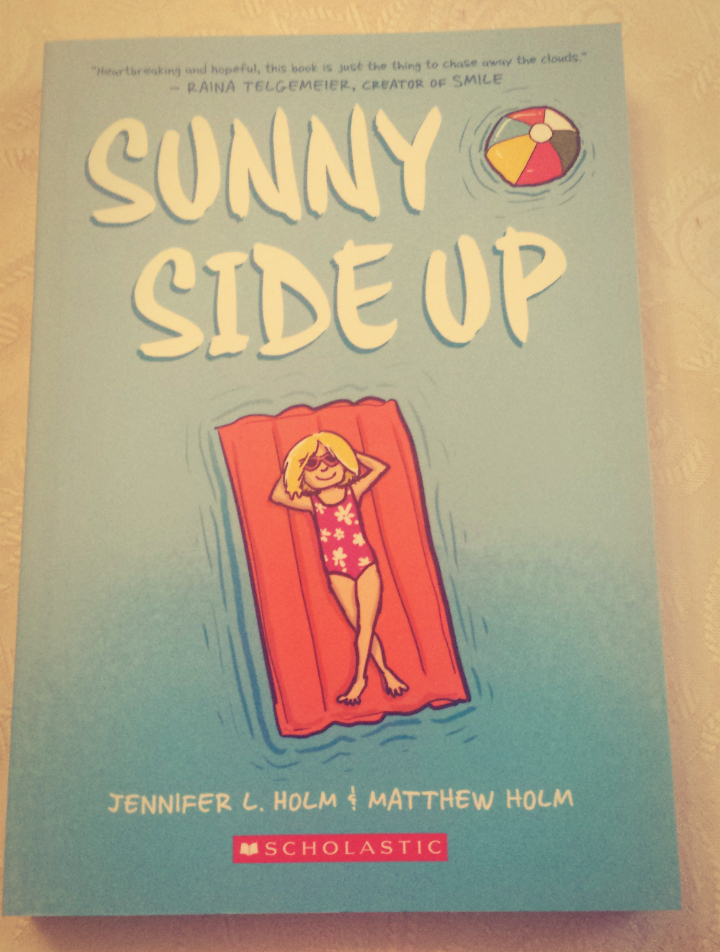
Today, I would like to talk about one of my favourite graphic novels for your junior grades: Sunny Side Up by Jennifer L. Holm & Matthew Holm. This very well-done novel tells the heartfelt tale of 10-year old Sunny Lewin, who goes to spend some of the summer of 1976 with her grandfather in Florida. Young Sunny has been sent away by her parents not as punishment, but as protection and distraction. Sunny’s grandpa lives in a retirement community and his idea of fun is not quite the same as young Sunny’s. Still, Sunny shows great maturity in doing her best to make the most of it. This graphic novel is told with great sensitivity from a child’s perspective. A child who is dealing with a lot in her life. With flashbacks to earlier points in time, little by little the readers become aware that Sunny has been sent to live with her grandfather while her parents help her older brother deal with his substance abuse. With thoughtfully constructed artwork, the Holm brother-and-sister duo showcase the sibling bond shared between Sunny and her older brother and how his substance abuse affects her life. Teachers, this is a great way to get your students talking about an issue that they might either have no awareness of, or be dealing with on a daily basis. Sunny’s resilience throughout the book is a poignant point that deserves discussion. How does a 10-year old learn to navigate these dark corners of life, and often by herself? The story builds on Sunny’s relationship with her grandfather, someone whom she loves very much, and her role at 10-years old as his keeper. Sunny tries to keep her grandfather in check about his smoking problem, and she plays along while he lies to her, until at one dramatic moment in the book, she loses her nerve. Here we see how this young child, with all of her 10 years, has roughed out life to arrive at a juncture where she will no longer tolerate being treated like a child, because as she proves, she has grown up enough to understand how reality works.

Teachers, your students can do various things with this graphic novel because it is so very versatile. You can dip quite easily into the arts and explore language through that lens, while at the same time fulfilling grade-specific expectations across different curriculum.

With a setting ground in the 1970s, your students can chart important moments in history from the 1970s and work their way forward, they can talk about ways in which the artist uses frames and panels and gutters and speech bubbles, and other graphic novel techniques to convey meaning, you can delve into psychology and the background of substance abuse and how it affects the person who is dealing with it, and his/her family. This book is teeming with things to teach your students, and the best part is, it comes in a form that doesn’t pose a hard sell! Your students will be so excited to jump right into the pages, you will only have to say when!

Teachers, if you are looking for resources to start a unit on this book, please visit my Teachers Pay Teachers account: Cross-Curricular Ideas when teaching Sunny Side Up


©booksnnooks.org All Rights Reserved
Championing Graphic Novels for Classroom Teaching

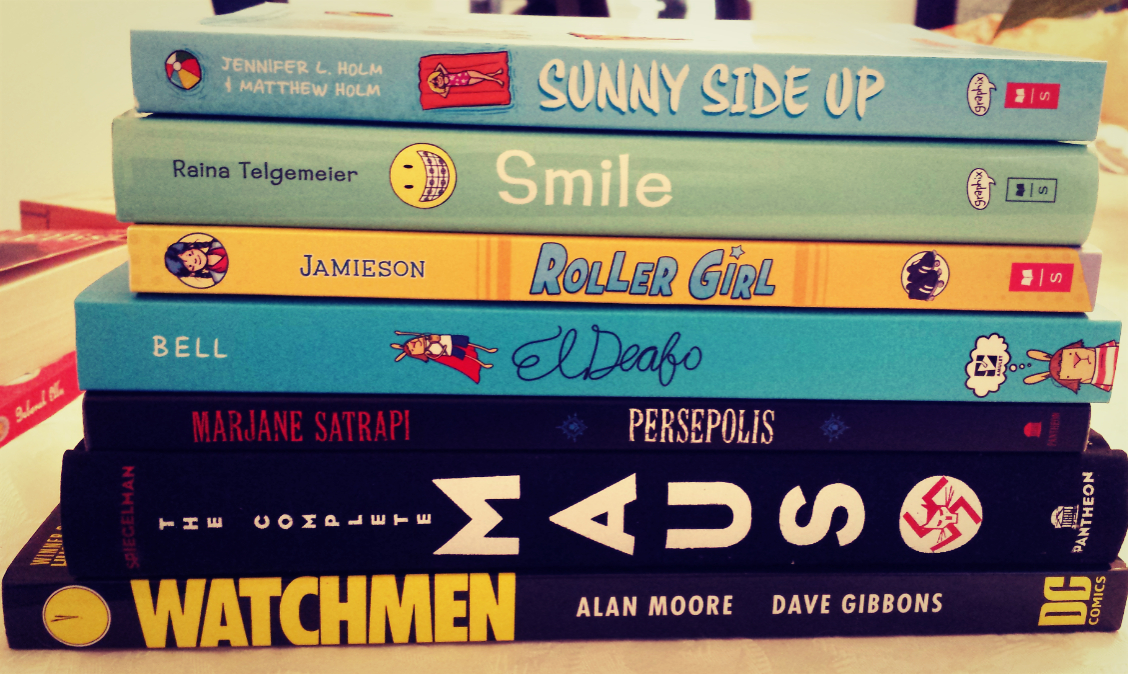
Some of my favourite graphic novels; great for teaching students Grades 4-12

As teachers, we like to revert to the tried-and-true classics when doing Novel Study Units, and teaching our students various bigger life themes. The likes of To Kill a Mockingbird, Inherit the Wind, The Great Gatsby, The Apprenticeship of Duddy Kravitz, Jane Eyre, The Importance of Being Ernest, Brave New World, 1984 and then of course those by the Great Bard, for the intermediate and senior grades. Trust me, I’ve done a good number of these in High School. And then there are the likes of Bridge to Terabithia, Freak the Mighty, Charlotte’s Web, Chronicles of Narnia for the junior grades.

Now, let me pose this question: Have you considered a graphic novel for your Novel Study Unit? I have talked to a lot of teachers, especially in the junior and intermediate grades, and they are incredibly distrusting of the graphic novel. It is viewed by many teachers as a medium of entertainment, and not learning, for their students. Granted, there are graphic novels out there that are created with the sole intent of entertaining, but a lot of incredibly clever graphic artists and writers, collaborate to produce thought-provoking and striking graphic novels.

I would like to make a case for the teaching of graphic novels in grades across the board. I believe they have much value to add to our students’ learning. First of all, graphic novels are not just about the pictures. They are about the relationship between text and image. They are about the meaning in between the panels and the way the characters are drawn and coloured. They are about what is omitted and what is included. They are about meaning and form at their very core. However, they are also incredibly accessible. Graphic novels have the power to engage students who are not willing readers of the traditional text. They have the know-how to capture this audience and potentially turn them into readers. Now, teachers, would that not be a cause for celebration?

Graphic novels further ignite creativity, they inject perspective and then offer other viewpoints contrasting with that first perspective. Art is introduced in an appealing way to students who might not necessarily find themselves drawn to it. The graphic novel has the unbridled power to marry different forms of expression to achieve greater meaning.

Several graphic novels written over the last few years have sought to take big risks and tackle radical topics. Sunny Side Up by the Holm brother and sister duo (Fear not, I shall review this one in time), El Deafo by Cece Bell, Persepolis by Marjane Satrapi, Maus by Art Spiegelman and Smile by Raina Telgemeier (a handful of my favourites) are some of the graphic novels that have burst out onto the scene and made an impact. From tackling big issues of substance abuse to identity and war in Iran, from physical disabilities to World Wars and the struggles of adolescence, these books, and others, have the power to change thinking. They have the power to begin passionate discussion among students. So, teachers, pray tell, do they not deserve a ranking among the greats? Just because they are “newer” and “different” does not make them unworthy of being entered into the canon of literature-teaching tools.

One of my personal favourites is Watchmen by Alan Moore. This masterpiece makes the movie look ridiculous because, within its pages, it houses depth of meaning and form. It catapults the reader into the story and pulls the narrative around that reader-creator relationship.

Graphic novels are not just quick books that you can read on a trip from Toronto to New York City. They are fast becoming vehicles in which to express explosive thought. So teachers, what say you? Give the graphic novel a chance?


©booksnnooks.org All Rights Reserved