Where Do We Go Now?: A Stunning Masterpiece

When a really close friend and talented emerging filmmaker suggested we watch Where Do We Go Now?, I was intrigued by the promise of scintillating content. And I was not disappointed. Directed by and starring Nadine Labaki, this film entirely in Arabic (with a French version and with English subtitles) was shot in 2011, and is set in a small village in Lebanon.

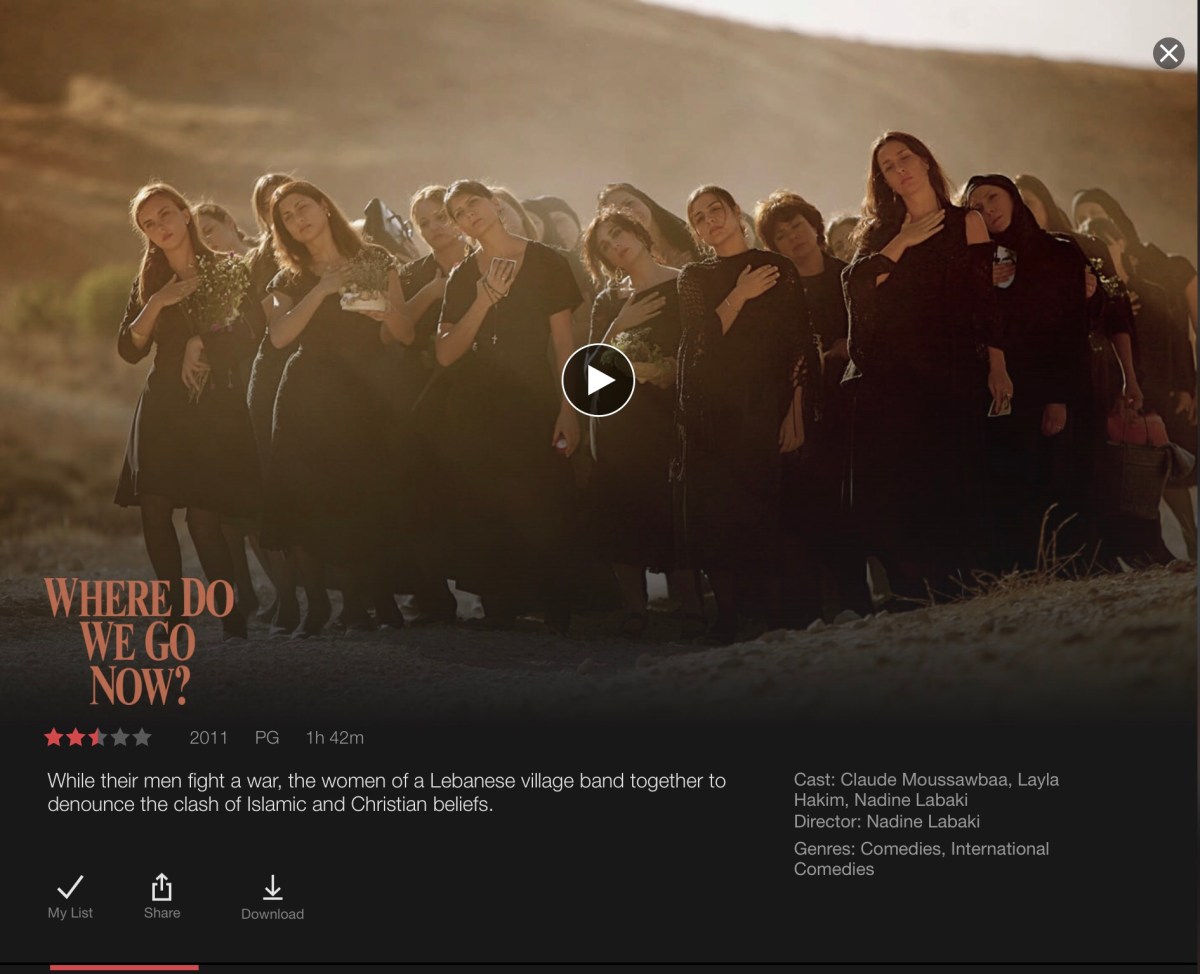
This film begins, as pictured above, with a group of women beating their breasts in mourning. They are mourning the loss of their husbands and sons to clashes between the two religions in their village: Islam and Christianity. The movie features strong themes of female leadership, religiously-motivated conflict, community, hope, forgiveness and love. It shows how when women lead, they lead with their head and not their hearts (contrary to popular belief), favouring the greater good over personal benefit or comfort. Mothers and sisters live their lives on tenterhooks, throwing themselves between testosterone-pumped men who are quick to jump to conclusions about their neighbour and react with violence. The women in this film showcase staggering presence of mind, grace and beauty in all its forms. They go to great lengths to keep the harmony in their village and their men alive. When heartbreak knocks on their door, they answer bravely not crumbling under pressure. They rise up to sacrifice their own personal dreams to save those around them. They conquer hate with bountiful love and understanding, and at no point do they let the bond their gender has necessitated they form come under threat. They band together, Muslim and Christian alike, and show forgiveness and humility. They are the protectors of their men, their homes and their small community. The incredible lioness-like spirit of a woman is so masterfully presented in this 102 minute film

Flipping our deeply-entrenched concept of religion on its head, this film tugs at the heart of spirituality, putting forth the notion that religion is in the heart and not based on whether we hold a cross in our hands when we pray, or whether we put our foreheads to the ground in prayer. It tries to make us see that conflict over religious beliefs is entirely ridiculous because at the end of the day, we all believe in one God.

Community is at the centre of this beautifully-crafted film with this theme echoing in the plots the women devise together. In the way they run to each other’s aid to protect their own and their fellow-women’s sons and husbands. In the way they prepare food together. In the way they work toward religious celebrations together. Even while their men fight each other, these women stick together and it is their sticking together through good and rough that leads to (SPOILER ALERT) salvation.

In its totality, it could be argued that this film challenges the importance of religion over community, ultimately unifying people through love.

While carrying conceptually-heavy material, this film is careful to lighten the mood with candid moments between the strong circle of women, musical pieces that provide gorgeous melodies and profound lyrical movement, and glimpses of hope and happiness.

This film needs to be seen to open up minds closed by conflict and the various divides infringed on us by society and based on the colours of our skin, whom we choose to love or the name of the God we pray to. A stunning masterpiece, this deserves a 5.0/5.0

©booksnnooks.org All Rights Reserved


The Deborah Ellis Installments (Part I): The Breadwinner Trilogy

Deborah Ellis is a renowned Canadian author who has written a number of books with a lens to promoting awareness about the plight of marginalized children in war-stricken countries. Her fiction and non-fiction are sensitively crafted to present the reality faced by many of these innocents.

In possibly her most famous books, The Breadwinner series, Ellis paints a picture of the life of women in war-torn Afghanistan. This entire series showcases an especially strong cast of female characters that will leave you feeling like you know them personally. Teachers, having worked in a library for a year, I have seen this series being read with great vigour by junior students. Granted these books might appeal more to your female students because the protagonists are mostly female, I do think there is great value in making it part of your teaching, as it allows your male students to understand and appreciate the hardships faced by many children and women in places like Afghanistan.

There are 4 books in the Breadwinner Series:

The Breadwinner

Parvana’s Journey

Mud City

My Name is Parvana

Today, I will speak to the first 3 as they follow closely in chronological order, and can be taught together over the course of a couple of months, if you so choose.

In The Breadwinner, we meet our leading girl, Parvana. She is bursting with energy and opinions, and is not the kind to bend over backward for anyone. Right away we get the sense that this strong young lady is built to tackle much. And much, she does. She is chosen to be the breadwinner of her family when the Taliban enforces bans on women leaving their home without a male companion. With Parvana’s father imprisoned for no fault of his own, her mother and siblings rely on her ability to dress up as a boy and go out into the market to continue her father’s job. Parvana is sharp and kind. She has a conscience that shines through her stubbornness. We understand as an audience that this is reality for a lot of Aghani girls. And at the young age of 11, Parvana must shoulder a lot of the responsibility if she is to help her family survive. Teachers, your students can view this first book through the lens of how the family structure is impacted by war.

In the second book, Parvana’s Journey, Parvana is reunited with her father, but separated from her mother and the rest of her siblings. The book opens with her at her father’s grave, and goes back at points in time to describe the short journey they took together to find her mother and siblings, before his mind and body gave out. For the remainder of the book, we follow Parvana on a harrowing journey as she must use both her cunning and strength to stay alive. This strong young girl has matured significantly since the last time we saw her, but she retains some of her best qualities, like her compassion. With this compassion, she makes and keeps a handful of friends. Teachers, your students can add to their understanding of the interactions of strangers in a war-torn country, and how the youngest of the population must fight for survival.

In the third book, Mud City, we reconnect with Parvana’s friend, Shauzia, whom we have met in the first book. Shauzia has ended up helping out at a Widow’s Compound on the border with Pakistan, but despite being clever and useful, she wants to venture beyond the grounds of the compound and start her own life. She is convinced that if she can reach the nearest city across the border in Pakistan, Peshawar, she can earn a living and then go on to have her own life and do great things. Shauzia does succeed in getting out of the Widow’s Compound, but life in the big city of Peshawar is not everything she bargained for. There is not much work to be had, and going hungry is just in addition to struggling to stay safe and alive. Teachers, this one will offer a bit of perspective on the internal world of an Afghani child, specifically a girl. It will allow your students to draw connections with their own hopes and ambitions, and those of Afghani children. It will also help them see that despite these hopes and ambitions, the contrasts in circumstances and opportunities is what makes achieving both possibly easier for them, and harder for their Afghani counterparts. This book offers teachings in different perspectives, gratitude and hard work.

Teachers, this entire trilogy is a great way to teach your students a bit of geography when you talk about Afghanistan and its location in the world, with reference to other countries such as Pakistan. Students can make connections to other countries they know of in the region. It can further offer the opportunity to delve into social studies as you discuss the government structure of then Taliban-led Afghanistan, and today’s present government. You can also use this to make comparisons with our own Canadian government, or other relevant governments.

The first three books in the series are great for grades 4-6 and offer a range of cross-curricular opportunities because of their versatility.

Stay tuned for a follow-up post where I will discuss the final book in the series, My Name is Parvana.


©booksnnooks.org All Rights Reserved


Charlie Newton: Hitchcock’s Female pièce de résistance

On a Hitchcock roll here.

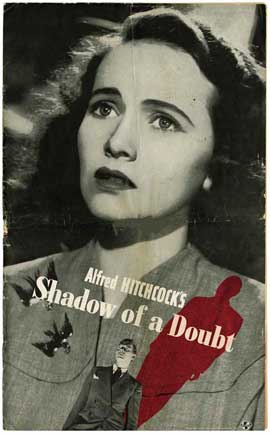
His 1943 Shadow of a Doubt was a psychological cocktail that I indulged in this weekend. I have watched  a handful  of movies from the 1940s, and not many of them showcase a particularly strong female. The leading ladies are abuzz with character (quite possibly just hysterics) in most cases, but tend toward the demure and genteel when push comes to shove.

Not so for Teresa Wright’s character of Charlotte “Charlie” Newton. The movie opens with a zoom-in of a window of a room in the neighbourhood of a town. A man is being chased by a pair of men. The scene cuts to a young girl on a bed, philosophizing about life and the sheer lack-lustre-ness of it all. This is  young Charlie who is named after her maternal Uncle, Charles “Charlie” Oakley. Charles Oakley is the man on the run, but from what? He sends a telegram to his sister saying he is coming for a visit. His sister, ever the naive and doting-on-all-she-loves woman, is thrilled to be reconnected with her brother.

Charles arrives and Charlie’s mood is lifted. Only briefly. She soon catches whiff of something sinister cooking within her uncle. As characters thither about in their roles of sister and husband and friend and detective, Charlie is paying the keenest of attention to her uncle and his odd behaviour. There is a murderer of widows on the run in her country. Is he her uncle?

This Film Noir is marked by moments of psychological twisting as Charlie is first painted as a potential love interest of Charles Oakley’s. The subliminal acts of holding her close and slipping a ring (which is a gift) on her finger border on the verge of incest. However, just when you become uncomfortable with the notion of an uncle being interested in his niece and vice-versa, a love interest for Charlie is introduced, and Charlie herself steps up her game.

She goes from doting niece to shrewd sleuth. She battles numerous dangerous situations and comes out alive. She is portrayed as protector of her mother and family, fiercely determined to venture into uncertainty just so she can uncover the truth. She threatens her uncle with death, and is quite adept at handling herself with grace and coy around men interested in her wit and charm and beauty. Charlie Newton is easily one of Hitchcock’s best leading characters. She has spunk, determination, smarts and grace. And all this packed into a classy slim-waisted dress on heels. It is important also to note the symbolism behind Charlie’s name. She is given the nickname of a boy, but she posses all the wherewithal of a respectable woman. She is portrayed as a character with many angles, all quite fascinating. Further, she is named after her uncle, but she is presented as an alternate “good” version of his character. All this, not bad for an early 1940s leading lady. Hitchcock has proven yet again that he was a master at making a movie that comprises varying levels of psychologically-acute layers, while injecting social issues of the times.

Teresa Wright, for her part, juxtaposes quite well her expressions of fear with grit and ability. Her character walks right into traps in the name of respect and obligation, but walks right back out when she is confronted with someone wanting to take advantage of her perceived vulnerability.

This movie utilizes dark and light to balance quite nicely the themes of crime committed by a man whose heart is ashen with his diabolical thoughts, and a young lady on the brink of womanhood who is bursting with life and wisdom and adventure.

Hats off Hitchcock, this one was spectacular.


©booksnnooks.org All Rights Reserved