Joel Osteen’s Think Better Live Better: Hope in 207 Pages

Rating: 5.0/5.0

Joel Osteen is a well-known name in religious Christian circles. This man has an extensive media persona and for all the right reasons. With the pseudo-miracle workers that prey on people’s vulnerabilities, it is easy enough to lump Joel Osteen into the same category, but this man actually spreads valuable messages. I have watched him on T.V. and read his books and my deduction is simply this, he actually cares about making a positive difference in the lives of the people he hopes to touch.

I recently read his latest book, Think Better Live Better that came out this Fall (2016), and if anyone should need testament of how a book can change your life, I would call into admittance this one. The thing that strikes me most about this book is the humility inherent in Osteen’s writing. He is obviously a man of much influence, but he still writes to his readers as one of God’s humble servants, with respect, kindness and gentleness. It is this tone that will render the readers most set in their ways more than willing to let him in to change them for the better. This book brims with positivism, and it is not just the kind that throws a bunch of feel-good sayings in your face and then scampers off the page. No, Osteen goes beyond that to offer real-life examples and opportunities for you to apply his teachings. He doesn’t heap it all into a few hundred pages. He breaks it down into little lessons that will get you thinking about how you can apply them to your life with the turn of each page. He repeats his positive messages over and over again and finds clever ways to connect his teachings, weaving in powerful and often poignant real-life stories.

Bursting with words of hope, faith, charity, kindness, and truly uplifting stories, Osteen’s genuine desire to help, to reach out and enable people shines through and makes you want to take stock of your own life and rise up to meet your divine destiny. This book is not exclusive to the religious or followers of only Christianity or even fans of Osteen. No, this book is for anyone who has lost themselves, lost hope or faith or lost the will to try harder. This is for those people who need someone to believe in them so they can straighten up and forge ahead to fulfill all they were meant to. In an age where we have become more aware about how to live healthy lifestyles, tapping into meatless diets and better fitness levels, there is something to be said for nourishing your emotional and spiritual selves. There is something to be said about the necessity for hope, and this book is literally hope in 207 pages. This book helped me navigate a dark time in my own life, and with each page I read I felt my own hope beginning to grow into its former self. If you are looking to love yourself again and to live a more fulfilled life where you can then leave a positive legacy, this would be my recommended go-to. If you do get around to reading it, I would love to hear what you thought!

©booksnnooks.org All Rights Reserved

Let’s Live with Gratitude, Dear World.

wp-1476040454749.jpeg

This is Thanksgiving weekend here in Canada, and having been deeply moved by the sermon at mass this morning, I found myself moving towards a post to share the same.

The sermon focused, rather aptly, on the spirit of gratitude. The priest began by sharing his own experiences of complaining about things in life when they don’t go his way. He acknowledged that as human beings we are prone to ingratitude and feelings of entitlement that lead us to believe that comfort and good things are due to us. As a result, when they don’t come our way as expected, we do not know how to react, cue an attitude of ingratitude. He emphasized that with such an attitude, it is impossible to live a fulfilling life. The cure he said? Switching out an attitude of ingratitude for one of gratitude. And how right he is. Being grateful for the positive in our lives and recognizing the value in the negative to help us grow, leads us to living joyful lives. Instead of whining about what is going wrong, why not think about all the things that went right? To keep with this spirit of spreading the message of leading a life of gratitude, I looked up (on Google IMAGES) a number of quotes, and a plethora of them is what I found. I am sharing some in this post because I think being grateful is something that may not come naturally to a lot of us, but it is something worth practicing everyday until it is natural. Being grateful will improve our quality of life. After all, it is only a matter of a change in perspective, a worthwhile investment that yields BIG dividends.

Ponder these then. They are beautiful.

This slideshow requires JavaScript.

P.S. To my readers all over the world, I thank you for visiting my humble website. If not for your loyalty, I wouldn’t post the things I do. XO.


©booksnnooks.org All Rights Reserved
The Beauty in Being Strong

Lately, a lot of things have culminated in me rethinking the concept of beauty. People look for symmetry in a face, a glow in the eyes, a toned set of thighs, well-cared-for feet, a crisp voice, a smile, and call these things beautiful. And yes, individually and cumulatively, these things are all beautiful. Art is also beautiful, so is the kind interaction between strangers on a street corner. There is beauty in the darkness, in the crosses we carry, in the pain of our everyday lives. And then, there is beauty in being strong. And I don’t mean the physical strength that can be attained through persistent cardio and strength-training over weeks and months and years. No, the strength I have come to value as beautiful is a strength that wades through the messiness of life and still manages to be gracious and hold on.

Like a lot of people out there, I have unsung heroes and role models in my life. There are my father and mother – my ultimate heroes, among a handful of others comprising family and friends. There are a lot of people I look up to, for waging gracious war with the many battles in their lives, and coming out, albeit a bit beaten, still standing, at the end. These people are beautiful to me. It is in their strength that I find value in life, in being kind even when it is hard to do so, in being gracious when there is nothing remotely resembling grace about something or someone else.

There is beauty in silence when harsh words can be exchanged to fuel fires. There is beauty in this ability to exercise restraint; beauty in the strength it takes for that restraint. There is also beauty in being strong where you are able to care for yourself and be someone others can rely on. There is beauty in being strong enough to sacrifice for others. There is beauty in standing your ground when you believe in something, often meaning that you are standing alone. There is beauty in being strong enough to forgive someone who has shattered your heart and sense of self, intentionally or otherwise. And finally, there is beauty in being strong enough to recognize that you are weak as a human and need to reach out to Jesus (or whomever you pray to, if you do) or someone you trust, to ask for help.

Sure, the beauty of this world puts a great emphasis on that which is pleasing to the eye, but when we learn to value being strong as beautiful, we can free ourselves of the surface elements that leave many of us feeling quite empty.

Within the messiness of our lives lies the opportunity to be strong, and with that opportunity, we can find an unwavering beauty.


© booksnnooks.org All Rights Reserved

Picture Book Spotlight: Educating Our Children about Homelessness

Homelessness is a growing concern in our society in North America. As Canadians we sign off on millions of dollars in relief aid to the needy in other countries, and as we should – because we are a generous lot and generosity helps make everyone a little richer, but what of the homeless in our own country? The poverty-stricken men and women, or worse still, children? No, to this problem we turn a blind eye, a deaf ear, we walk quicker. And I think that stems from a culture that is lacking in education around this concept of homelessness. What is homelessness? What does it look like? Whom does it affect? These are questions we need to ask ourselves before we as adults make quick judgments about homeless people we see, and then pass these judgments off to our children. Children feed off the exemplars in their lives. They practice what they see, not what is preached.

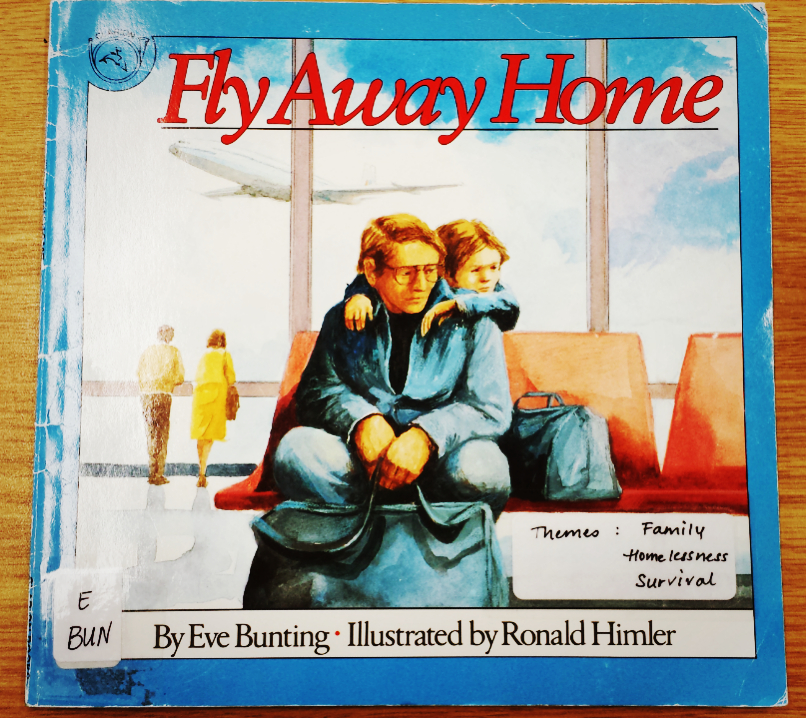
So, when I came across Fly Away Home by Eve Bunting, two things happened. For one, it broke my heart, and then, it provided me with an Aha! moment. I could use this book to teach my young students a little about what homelessness looks like! And so, I did a Read-Aloud using this book with students in Grades 1-3.

Told from the perspective of a 5 year-old boy who is homeless and lives in an airport with his father, this story is delivered with compassion and sensitivity. The facts are laid out for us to see. The day-to-day lives of the father and son, as they struggle to outwit airport security by blending into the travelling consortiums that hustle and bustle through the airport, are shown to us. The little boy learns a lot of wisdom at a young age, and this book nudges in a couple of really good metaphors to help understand the mindset of a homeless child better. Teachers, you can pause at various moments in the story and ask your students why the father and son are doing the things they are, or what certain things mean. Their answers will surprise you, and in turn you will be able to surprise them with yours. Among other themes that Bunting weaves into this delicate tale, are those of family and survival. The things you do to stay together and stay alive and well. There are sad moments to this story too, but there are moments of hope and positivity, where students can learn that people can still shine bright their candles of hope in the bleakest of situations. When you have finished reading this with your students, you will find they adorn a new-found appreciation for the homeless and their difficult lives. And in doing so, you will help to make them more sensitive to the aches of society around them.


©booksnnooks.org All Rights Reserved


Picture Book Spotlight: A Slight Change in Perspective

Let’s face it then, in today’s world with messages about the way we should act and dress and talk and smile, children don’t really have a fighting chance to decide who they are and love themselves for it. There is so much pressure on our little ones today, that it is a wonder not all of them break under it. Little girls as old as 5 are wearing makeup…trust me, there is a lot wrong with that. And while that is in itself a discussion for another blog, I would like to talk about a Picture Book (Because let’s keep true to the main obsession of this blog, right?) that does a lot of good in helping children understand their own worth, and taking them on one of their first steps to loving themselves. All this with a slight change in perspective.

Amy Krouse Rosenthal is a gifted Children’s Author, and today I want to profile my favourite book from her collection: Spoon. Spoon is a book about…you guessed it, a spoon. A spoon who feels that he is not as special as the forks and the knives and the chopsticks of the world. He ambles on feeling sorry for himself and pining away at the special qualities that his other kitchen folk posses. Until, of course, a slight change in perspective helps him appreciate what he is.

Rosenthal uses the simple, yet profound analogy of being a spoon, to help children understand that each of them is special as (s)he is. With all the conformity inherent in our world, where being part of the pack is championed, the outliers don’t often have the chance to offer their special talents to our world. Rosenthal tries to help with that. Replete with illustrations that tickles a child’s imagination, and dialogue that brings spoons everywhere to life, this book offers children the rare opportunity to see the world differently in any situation, if they just learn how to change their perspective. It offers an option to put a positive spin on just about anything that might look particularly dire. Children have the chance to learn how to be grateful for what they have and who they are. And gratitude is much needed in a world bursting at the seams with entitlement.

So, if you’re a primary teacher, a parent of a child between the ages of 4 and 8, this books MUST be on your shelf. Who knows, that child sitting in the corner in the back of the room, might have his world turned to a shining view after you’ve read this one out loud!

© booksnnooks.org All Rights Reserved