Aaron Becker’s Journey: A True Picture Book

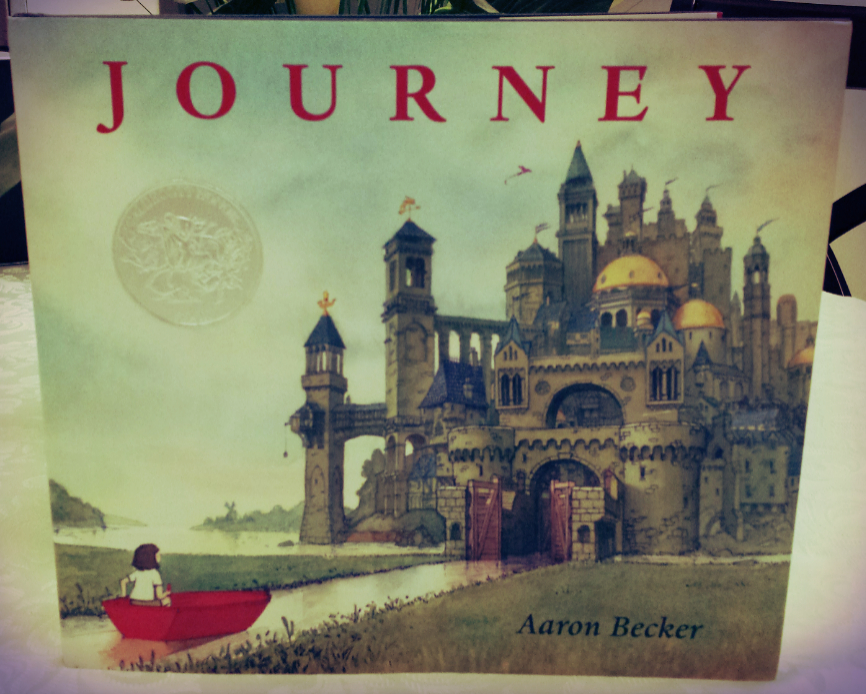
I was first introduced to Aaron Becker’s Journey while doing a teaching placement not too long ago. What I did not realize at first was how versatile this book would become, on not only an age level, but a conceptual and skill-teaching level as well. I have since read it to students at the primary and junior levels, and each time, this book has not failed to create a splash. Becker relinquishes the use of words to tell a story completely in the hands of a child’s imagination. He trusts our young readers, as we must, to make their own meaning out of this heartfelt tale.

I will intentionally not discuss the plot of this book, as I do want to create any skew toward a certain interpretation when the book provides for many. Suffice to say, this book is about a young girl who begins a journey and along the way, discovers much about herself and life.

Juxtaposing grayscale pictures with bold singular colour in the beginning, and then opening wide a world blossoming with colour as the book progresses, Becker unfolds a world that students can envelope themselves in. With magical crayons and castles, boats and hot air balloons, rescue missions and the king’s guards, this book will allow your students to draw the important messages of friendship, selflessness, generosity, imagination and compassion. The sensitively-coloured and poignantly-drawn illustrations provide your students with the opportunity to lose themselves in another world where they can tell you a story as it plays out in the turning  pages. For once, you will not be the one narrating, they will, and they will take much pleasure in making their own tale. The thing I love most about this book is that it allows for a variety of different levels of interpretation that your students can attach themselves to. It prods their critical-thinking and problem-solving skills, it allows them to use language to describe pictures, it helps them with recall and attention to fine detail, and at its best, it provides them with the opportunity to acknowledge the value of a variety of perspectives. It is especially great for those of your students who just do not like reading; a great place to start to show them that books can be fun and instructive, without the burden of a multitude of words.

Teachers, this book is well worth the investment, and a true gem that will prove timeless for your students each year.


©booksnnooks.org All Rights Reserved
Harvey: A Simple, Yet Artistic, Account of Loss and Grief

Rating: 5/5

Let me begin with a warning that today’s blog discusses a concept that makes many of us grimace with pain. Death. Five letters that can quite literally shatter our lives. When I came across this book by Hervé Bouchard and Janice Nadeau, I was both deeply moved and in awe.

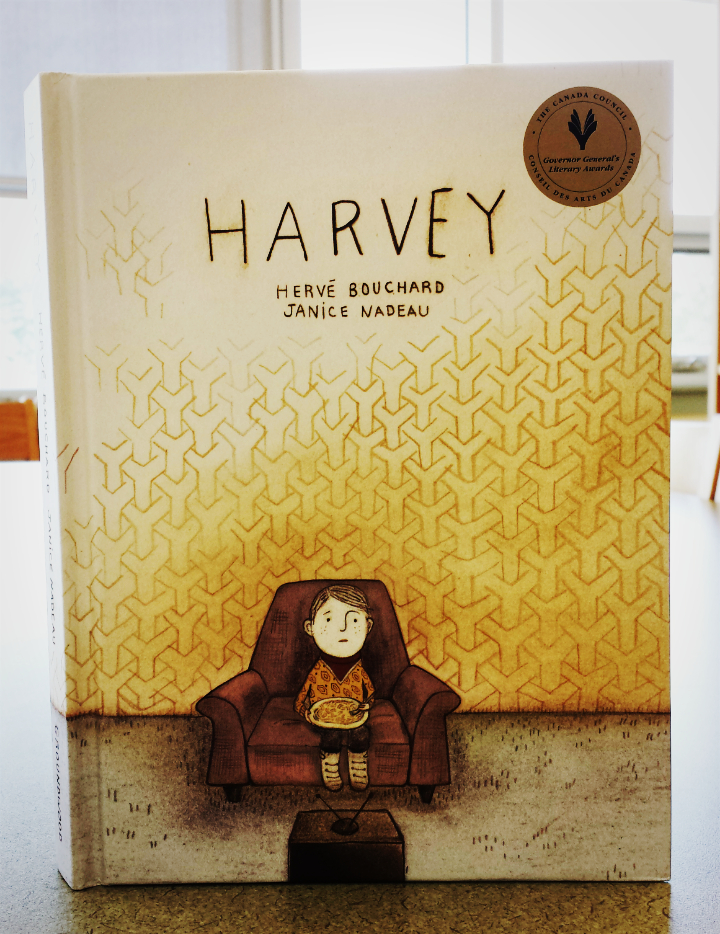
Harvey, written by Hervé Bouchard and illustrated by Janice Nadeau is a project that truly synchronizes illustration with text. And with that segue, I will begin with the technical elements that make this book a gem to own. When I think about categorizing this book, I am unsure whether it falls within the realm of picture book, it is a bit too long for that, graphic novel, while it does have graphic illustrations and real-time dialogue(minus the speech bubbles) it is missing the characteristic panel-structure of graphic novels, or junior novel, the subject matter and the textual length and level seem to offer signs of this. I then came to the conclusion that it really is all 3: picture book with a hint of graphic novel and junior novel.

Now, the subject matter focuses on the death of our main character, Harvey’s, father. Harvey and his brother, Cantin, live in Quebec, and on their way home from school one Spring day, find an ambulance and a crowd of people outside their home. A stretcher holding a blanketed figure is brought out of their house with their mother wailing behind. Then, a key set of events is set off in slow motion as our writer and illustrator quite dexterously capture the grief inherent in loss. A child often processes the loss around death differently than an adult. And while the stages of grief are similar for more or less all of us, children often are left confused and filling in the  gaps that a loved one’s demise has created. There is the knowledge of loss, but pieces of  life seem to move out of kilter, with a child having to struggle to return to some semblance of normalcy. Harvey processes his loss in a very practical matter. He lays out the facts and then follows through on what must be done to deal with his father’s death. His younger brother, Cantin, however, takes a different route when dealing with his loss. His reaction is more emotive. Harvey is the older one of the two and perhaps this difference in reaction is in part due to age and maturity. I would argue though that loss affects us all differently depending on our different personalities. The matter-of-fact text that Bouchard uses to explain the progression of events gnaws at your mind and heart. Nadeau is exceptionally  clever with her use of colours and lines and spaces. She employs darker, smudged-out, and consistently  faded and ragged colours to convey the heaviness of loss. A “grayness”, both of feeling and colour, hover over throughout the book. I don’t normally tout the illustrator of the picture books I review, but that is usually because the text stands out more to me. In this book, Nadeau’s illustrations take the cake. She is superbly talented in conveying the gravity of emotion and state of mind that someone dealing with loss encounters. And it is this talent of hers that I believe renders this book a masterpiece.

Winner of the Governor General’s Literary Award, this book is a gentle reminder of death looming in lives. It offers a raw interpretation of loss suffered by a child and in doing so, makes us as adults more keenly aware of how we can better support our young ones through such a difficult process.


© booksnnooks.org All Rights Reserved


Picture Book Spotlight: Educating Our Children about Homelessness

Homelessness is a growing concern in our society in North America. As Canadians we sign off on millions of dollars in relief aid to the needy in other countries, and as we should – because we are a generous lot and generosity helps make everyone a little richer, but what of the homeless in our own country? The poverty-stricken men and women, or worse still, children? No, to this problem we turn a blind eye, a deaf ear, we walk quicker. And I think that stems from a culture that is lacking in education around this concept of homelessness. What is homelessness? What does it look like? Whom does it affect? These are questions we need to ask ourselves before we as adults make quick judgments about homeless people we see, and then pass these judgments off to our children. Children feed off the exemplars in their lives. They practice what they see, not what is preached.

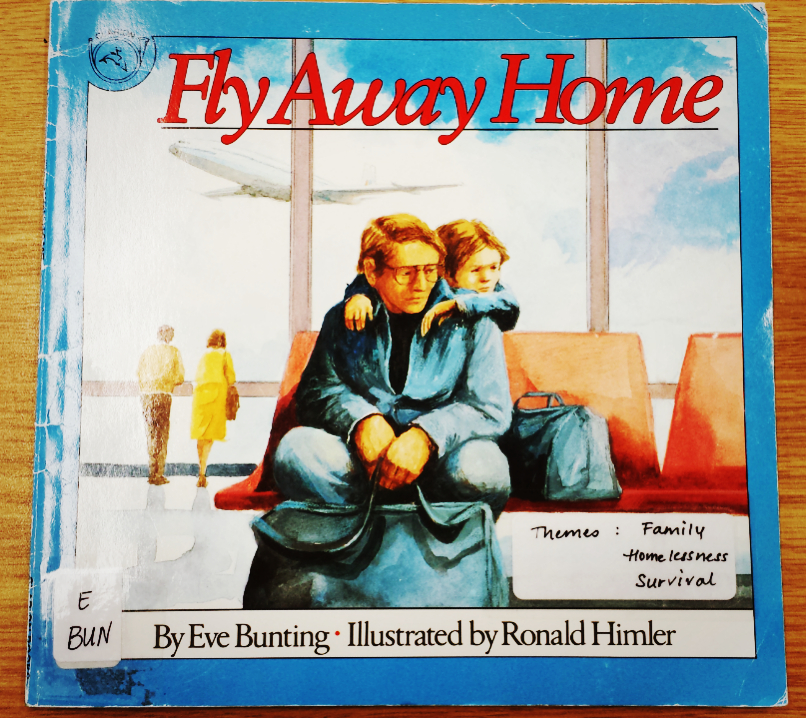
So, when I came across Fly Away Home by Eve Bunting, two things happened. For one, it broke my heart, and then, it provided me with an Aha! moment. I could use this book to teach my young students a little about what homelessness looks like! And so, I did a Read-Aloud using this book with students in Grades 1-3.

Told from the perspective of a 5 year-old boy who is homeless and lives in an airport with his father, this story is delivered with compassion and sensitivity. The facts are laid out for us to see. The day-to-day lives of the father and son, as they struggle to outwit airport security by blending into the travelling consortiums that hustle and bustle through the airport, are shown to us. The little boy learns a lot of wisdom at a young age, and this book nudges in a couple of really good metaphors to help understand the mindset of a homeless child better. Teachers, you can pause at various moments in the story and ask your students why the father and son are doing the things they are, or what certain things mean. Their answers will surprise you, and in turn you will be able to surprise them with yours. Among other themes that Bunting weaves into this delicate tale, are those of family and survival. The things you do to stay together and stay alive and well. There are sad moments to this story too, but there are moments of hope and positivity, where students can learn that people can still shine bright their candles of hope in the bleakest of situations. When you have finished reading this with your students, you will find they adorn a new-found appreciation for the homeless and their difficult lives. And in doing so, you will help to make them more sensitive to the aches of society around them.


©booksnnooks.org All Rights Reserved