Hitchcock’s Rope: Philosophical and Gripping

My fascination with Alfred Hitchcock began years ago when I was little and would watch his movies with my parents. I have to admit, at the time, I didn’t grasp a lot of what was being enacted before my eyes, but now in my young adulthood, I am revisiting Hitchcock’s movies, and I have got to say, his genius is still relevant today.

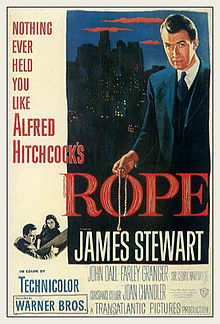
I recently watched the movie, Rope. This 1948 film stars my favourite actor from that generation, James Stewart. Now, if you’re thinking that name rings a bell, you have likely seen him in the holiday classic, It’s a Wonderful Life. James is a superbly talented actor and a timeless one at that, but that is for another day and another blog post.

This movie opens with two of our lead characters, Bernard and Philip, strangling their friend, David, to death. The romantic philosophy of being superior beings collaborating in the masterful art of murder is touted as their raison d’etre, and their reason for committing this heinous act. This philosophy as we learn, has been first espoused by Nietzsche and taught by their college professor, Rupert (James Stewart). The duo then proceed to hold a dinner to “celebrate” this “achievement”. As the guests arrive, we see a very different aftermath play out with the two characters. Bernard is presented as the callous and charismatic psychopath, and Philip is really losing his  marbles with guilt. Enter their college professor, Rupert,  and the evening’s events begin to unravel themselves.

As is his signature trademark, Hitchcock very dexterously incorporates subtle angles in his filming that seek to foreshadow what is to come. The symbolism inherent in the various acts carried out by the characters in this movie, is exceptional. In one scene (AND SPOILER ALERT), Bernard is packaging a collection of First Edition books for the dead man’s father to take home, and he uses the same rope he killed his son with, to tie the books together.

I particularly enjoyed this movie because it got me thinking about society and the hierarchy of beings when it comes  to differentiating between superior and inferior. We see this as a recurring trend today with killings the world over, perpetrated by those holding twisted versions of concepts surrounding race or religion or gender. Friedrich Nietzsche’s Ubermensch or “Superman” philosophy is at the heart of this idea, where he essentially tosses out the concept of Godly values, in favour of an alternative system of values created by those who view themselves as superior to their fellow human beings. Bernard is that character in Rope. With his inflated sense of self, he rests content in the fact that he has carried out the perfect artistic venture to prove his superiority. However, as the movie hurtles towards its inevitable conclusion, all is not what it seems.


©booksnnooks.org All Rights Reserved
George Leigh Mallory: The First to Summit Everest?

Rating 4/5

George Leigh Mallory

For most of you, that name does not ring a bell (Unless you’re a mountaineering enthusiast of course, or just a rare brainiac). You are however, in all likelihood, familiar with the names of Edmund Hillary, a mountaineer from New Zealand, and Tenzing Norgay, a Nepalese Sherpa who made the journey with Hillary, the first 2 climbers to conquer the summit of Mount Everest in 1953. Little is known about the brave man, George Leigh Mallory, who in 1924, led the 3rd expedition from England to reach the summit of Everest. Mallory and his climbing partner, Andrew “Sandy” Irvine disappeared in June 1924, and whether they reached the summit or not has been a cause for much speculation since they disappeared 92 years ago.

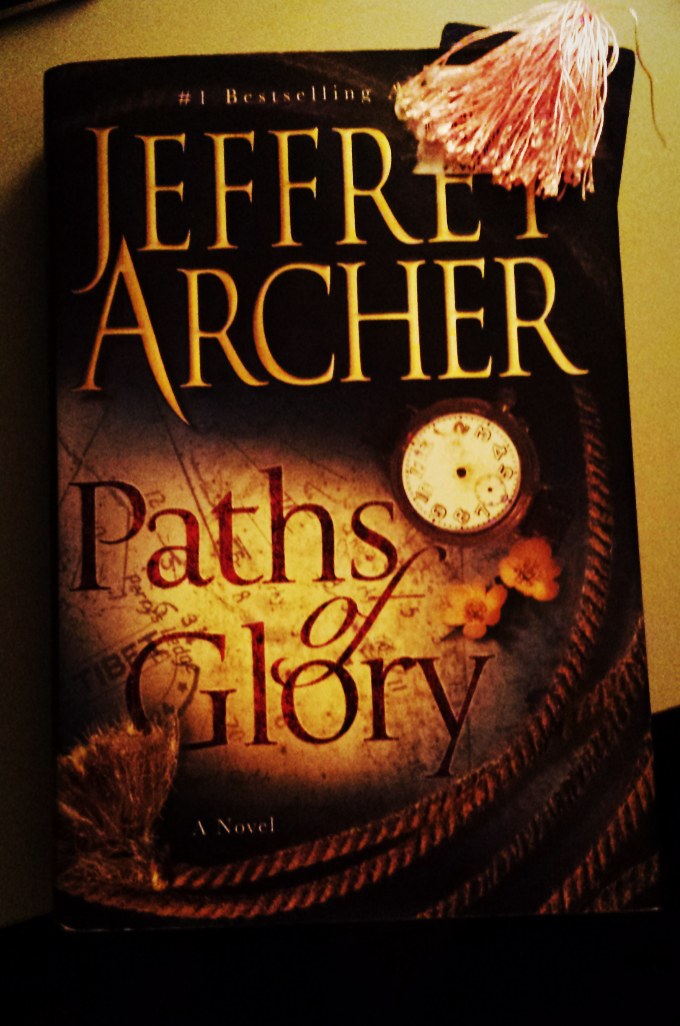
Jeffrey Archer, a former British politician, has written a page-turner with George Leigh Mallory as the charismatic Protagonist, titled, Paths of Glory. Mallory is positioned as a devil-may-care gentleman who seems to scale the most domineering mountaintops with little regard for failure. Although Archer’s writing style leaves for something to be desired, he has a flair for fluffing up the facts to deliver tones of adventure,  and creating dramatic hooks that leave you hanging and hungering for the end. And while the world has yet to  find out whether George Mallory and Sandy Irvine reached the summit in 1924, Archer ends his narrative having taken a side. The facts that have been uncovered over the years are presented with much pzazz to deliver a cast of characters who are true to their roles and remain, to the very end, very convincing. Mallory’s family and friends are constructed as integral characters to the story, and Archer shows a lot of respect to Mallory’s Expedition team and his beloved wife, Ruth Mallory.

The relationship between Ruth and George Mallory provides for much heightened drama as it weaves together a roller-coaster of emotions that take the reader on the journey of a wife longing for her husband, and a man torn by the ache to be with his family and the relentless desire to achieve his ambition.

This was an adventure that spear-headed my need to research more about the 1924 Expedition to Everest, and George Mallory’s Life. There is much information out there, and most of it says the same thing, but George Mallory seems to exude a mystery and elicit desire to know what happened to him on his journey up the mountain. Mallory’s body was found in May of 1999, 75 years after he disappeared, by a team of American climbers. There is fascinating video footage shot by the team upon the discovery:  https://www.youtube.com/watch?v=UFr1KdY6aiw

And while Archer’s book is but one way to reconcile the mystery around the final moments of Mallory and Irvine, Archer leaves his readers with a feeling of awe, thoroughly honouring this fascinating and skilled mountaineer who tried to defy the limitations of his time, and conquer a giant.

If you’re looking for dexterity of writing style, this is not the book for you, but if you thrive on adventure and mystery, then this is a must-read.

©booksnnooks.org All Rights Reserved