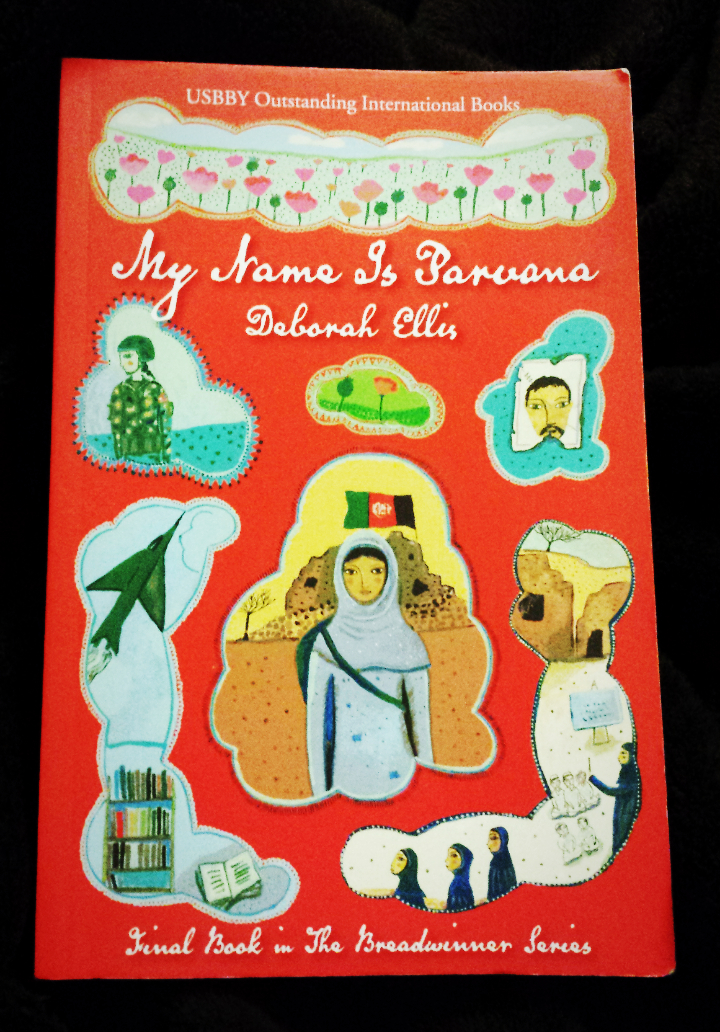
The Deborah Ellis Installments (Part II): My Name is Parvana

As promised, here is Book#4 in the Breadwinner Series, My Name is Parvana by Deborah Ellis.

In this last book, we meet an older Parvana. She is 15-years old now, and has been through more heartbreaking tragedy. When the story opens, Parvana is in prison. She has been captured by American soldiers, while wandering through a bombed-out school site. As we follow Parvana through her ordeal in prison, the story jumps back into the past to fill in the gaps with what has transpired since we last met her. Ellis does a fantastic job of superimposing the past on the present. Parvana is no longer the feisty young girl with a quick tongue. No, now she holds her tongue to create a deafening silence when questioned by the American soldiers. Over and over and over and over again. Yes, Parvana has matured. And logically so, because she has lost more, and made more difficult and selfless choices. Her innocence is replaced with shrewdness and air-tight resolve. If she was strong when we were first introduced to her, she possess mammoth strength now. If, as readers, we admired her courage and smarts in the beginning, we will love her for these now. Ellis reaches into the soul of Parvana’s character and brings her to life. She makes her feel like a real person. And therein lies a huge portion of Ellis’ talent; her ability to make her characters come to life. It is no wonder we feel a closeness to them. Ellis does a great justice connecting her audience to children around the world who have no voice to fight for themselves. In this series, and finally, in this book, Ellis gives them all a voice. Especially through Parvana’s silence while she is in prison, we see the grace and bravery with which this young girl operates.

Teachers, your students can compare Parvana’s life to their own. They can make connections and then draw contrasts. They also get to understand a bit about how things work in military prisons in areas of war. This book can even be done with older grades (intermediates – 7 & 8) as a stand-alone with a thorough backstory provided. Students can jump into the psychology behind scare tactics and how prisoners are treated in war-torn countries, even if they are innocent, and even if they are children. You can use this as an opportunity to talk about bigger concepts in their basic form, such as different types of governments and their structures, democracy, justice and injustice, the effects of perception on belief. Your students can further see hope and sacrifice at one of their bests through the many sacrifices made by different characters, and the hope kept alive by others.

Teachers, you can also talk about the Canadian Women for Women in Afghanistan Organization and their not-for-profit endeavours to improve the lives of women in war-ridden countries such as Afghanistan. Deborah Ellis is a true genius at her work, and she has the passion to make her work endearing and relatable.

So, even if you don’t actually end up teaching this last book, you yourself will find it a worthwhile read. To say it is an eyeopener would be too much of a cliché.


©booksnnooks.org All Rights Reserved


The Deborah Ellis Installments (Part I): The Breadwinner Trilogy

Deborah Ellis is a renowned Canadian author who has written a number of books with a lens to promoting awareness about the plight of marginalized children in war-stricken countries. Her fiction and non-fiction are sensitively crafted to present the reality faced by many of these innocents.

In possibly her most famous books, The Breadwinner series, Ellis paints a picture of the life of women in war-torn Afghanistan. This entire series showcases an especially strong cast of female characters that will leave you feeling like you know them personally. Teachers, having worked in a library for a year, I have seen this series being read with great vigour by junior students. Granted these books might appeal more to your female students because the protagonists are mostly female, I do think there is great value in making it part of your teaching, as it allows your male students to understand and appreciate the hardships faced by many children and women in places like Afghanistan.

There are 4 books in the Breadwinner Series:

The Breadwinner

Parvana’s Journey

Mud City

My Name is Parvana

Today, I will speak to the first 3 as they follow closely in chronological order, and can be taught together over the course of a couple of months, if you so choose.

In The Breadwinner, we meet our leading girl, Parvana. She is bursting with energy and opinions, and is not the kind to bend over backward for anyone. Right away we get the sense that this strong young lady is built to tackle much. And much, she does. She is chosen to be the breadwinner of her family when the Taliban enforces bans on women leaving their home without a male companion. With Parvana’s father imprisoned for no fault of his own, her mother and siblings rely on her ability to dress up as a boy and go out into the market to continue her father’s job. Parvana is sharp and kind. She has a conscience that shines through her stubbornness. We understand as an audience that this is reality for a lot of Aghani girls. And at the young age of 11, Parvana must shoulder a lot of the responsibility if she is to help her family survive. Teachers, your students can view this first book through the lens of how the family structure is impacted by war.

In the second book, Parvana’s Journey, Parvana is reunited with her father, but separated from her mother and the rest of her siblings. The book opens with her at her father’s grave, and goes back at points in time to describe the short journey they took together to find her mother and siblings, before his mind and body gave out. For the remainder of the book, we follow Parvana on a harrowing journey as she must use both her cunning and strength to stay alive. This strong young girl has matured significantly since the last time we saw her, but she retains some of her best qualities, like her compassion. With this compassion, she makes and keeps a handful of friends. Teachers, your students can add to their understanding of the interactions of strangers in a war-torn country, and how the youngest of the population must fight for survival.

In the third book, Mud City, we reconnect with Parvana’s friend, Shauzia, whom we have met in the first book. Shauzia has ended up helping out at a Widow’s Compound on the border with Pakistan, but despite being clever and useful, she wants to venture beyond the grounds of the compound and start her own life. She is convinced that if she can reach the nearest city across the border in Pakistan, Peshawar, she can earn a living and then go on to have her own life and do great things. Shauzia does succeed in getting out of the Widow’s Compound, but life in the big city of Peshawar is not everything she bargained for. There is not much work to be had, and going hungry is just in addition to struggling to stay safe and alive. Teachers, this one will offer a bit of perspective on the internal world of an Afghani child, specifically a girl. It will allow your students to draw connections with their own hopes and ambitions, and those of Afghani children. It will also help them see that despite these hopes and ambitions, the contrasts in circumstances and opportunities is what makes achieving both possibly easier for them, and harder for their Afghani counterparts. This book offers teachings in different perspectives, gratitude and hard work.

Teachers, this entire trilogy is a great way to teach your students a bit of geography when you talk about Afghanistan and its location in the world, with reference to other countries such as Pakistan. Students can make connections to other countries they know of in the region. It can further offer the opportunity to delve into social studies as you discuss the government structure of then Taliban-led Afghanistan, and today’s present government. You can also use this to make comparisons with our own Canadian government, or other relevant governments.

The first three books in the series are great for grades 4-6 and offer a range of cross-curricular opportunities because of their versatility.

Stay tuned for a follow-up post where I will discuss the final book in the series, My Name is Parvana.


©booksnnooks.org All Rights Reserved