So, this month schools in the Catholic Board celebrate the virtue of Gratitude. Personally, I think it is a good idea to inculcate in our younger generation the concept of being thankful every day, however, having an entire month dedicated to this virtue is a good start. Today, I had the pleasure of leading a junior class to dig deep and find out what they were thankful for. This is what we came up with:
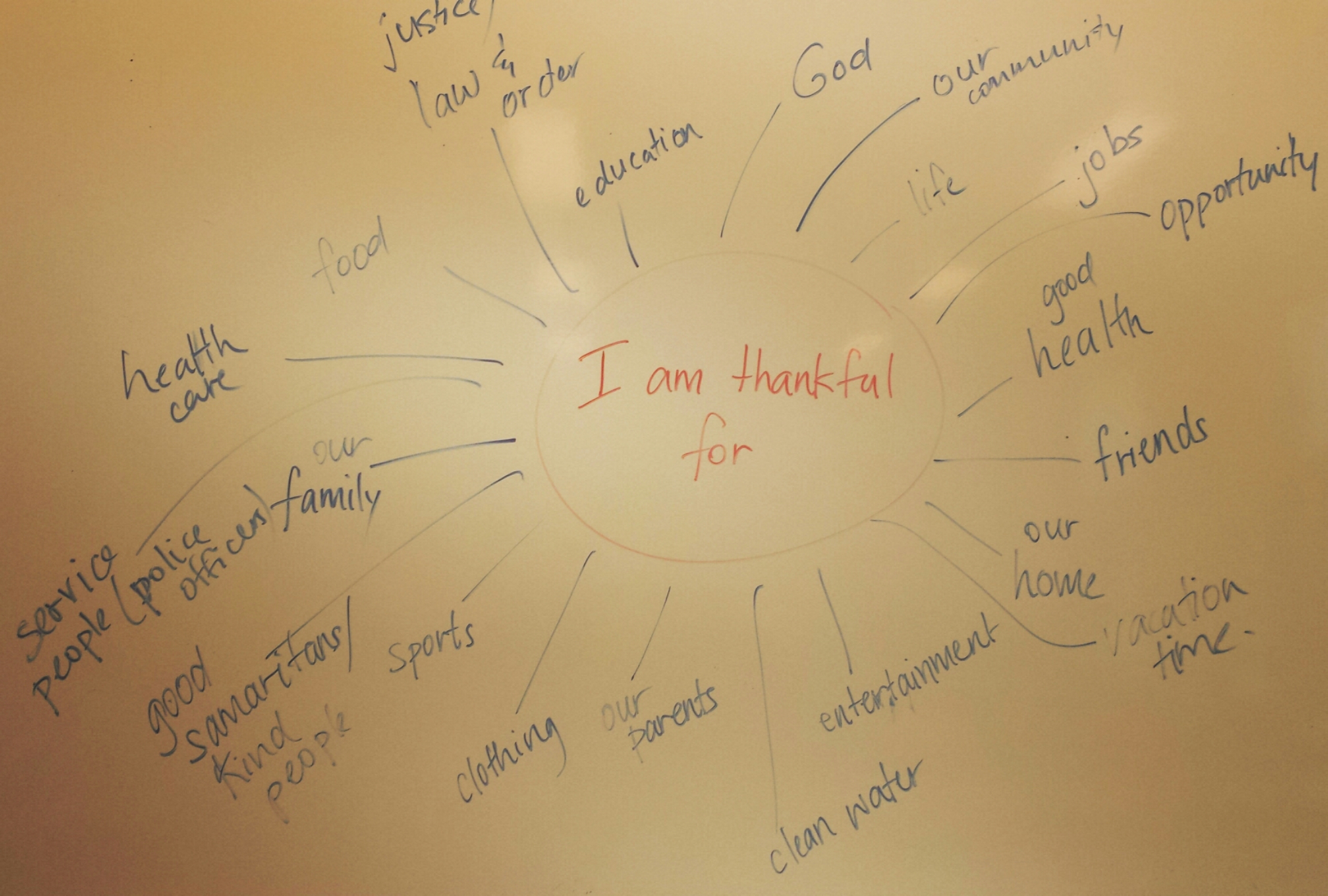
Initially, students threw out the tried-and-true: food, family, home, clothing, but then they began to really think about the concept of gratitude, and came up with being thankful for kind people and opportunities in life and our healthcare system(even if it isn’t perfect). This brainstorming session was done to help students prepare for a thanksgiving prayer they were to write. And while this is a great way to get your students thinking about what they are grateful for, it is not the only thing. Below, I have outlined some other ways to carry out activities to promote a spirit of gratitude in your students.
Other Ways to Incorporate the Spirit of Gratitude in Your Class:
#1 The “I am thankful for…” Display Board (Individual)
Set up a display board in one area of your classroom. Give it the title, “I am thankful for…” Each week, as a combined cross-curricular activity of art and writing (appropriate for all grades K-12), have each one of your students draw and colour and then elaborate (in writing – a sentence or just a word for the younger grades) on something they were thankful for that week. This activity can be done on the Friday so students have plenty of time during the week to think about what they can use. Remind students constantly during the week, if opportunities arise where they could be grateful for something, and have them bank these for later. Since artwork will have a weekly turnaround, have students make their own “I am thankful for…” folders (simple cream-coloured duo-tangs that they can decorate for an additional art activity). All work, once it is taken down from the display board, can be added to their individual folders for a keepsake of what they were thankful for that particular year. This could serve as a reminder when things are particularly rough in their lives and they are searching for positivity to get them through.
#2 Thank You Cards (Individual)
These are a practical and thoughtful way to reach out to others in the community and say a special thank you. Once a month (and this could be done in lieu of contributing to the display board idea above one week, if you choose to also do that), have students make THANK YOU cards. Each month they have to choose someone different whom they can say thank you to. Brainstorm with them different people in their lives they should be grateful to (parents, grandparents, siblings, other relatives, janitors, secretaries, principals, teachers, school crossing guard, their family physician, firefighters, police officers etc.). You could also have all the students make THANK YOU cards for different community helpers and then mail the cards to them, or drop them off if they are close enough. This activity also has the added advantage of serving as a dual art and language project and is appropriate for any grade from K to 12.
#3 Thank You Movie (Group Work)
This activity would best be suited for grades 5 and up, and would combine elements of multi-media, language, drama, art and so on. Students can create a movie choosing 5 (or fewer) different people in their lives that they are grateful for. They would then have to act out the roles these people play in their lives (students would have to agree as a group who these people will be – e.g. they would be parents in general and not specifically one student’s parents). They would film their enacting of these people’s roles in their lives and then combine technology elements (use iMovie, MovieMaker or other editing software they might be comfortable with) to add reasons why they are grateful for these people. Remind students to be respectful and thoughtful in their creations. Provide examples by repeating the above brainstorming activity as a class. Give students graphic organizers to record some of the ideas being brainstormed as a class. Allow them creative license to provide whatever twist on this project that they would like. Typically, allowing them a few weeks to put this together would be ideal.
And teachers, really, the sky’s the limit when it comes to teaching your students the virtue of gratitude. Let’s face it, we are educating quite an entitled lot these days, and a little bit of time taken to teach them valuable life lessons, would go a long way.
©booksnnooks.org All Rights Reserved

 Books 'n' Nooks