So, I don’t use the term “Genius” very often. Sure, Einstein was a genius and your dog might be a genius because he’s figured out which one of your twin nieces is Judy and which one is Jenny before you have, but in a world saturated with people trying to achieve the ultimate, my concept of genius is reserved for a scant few.
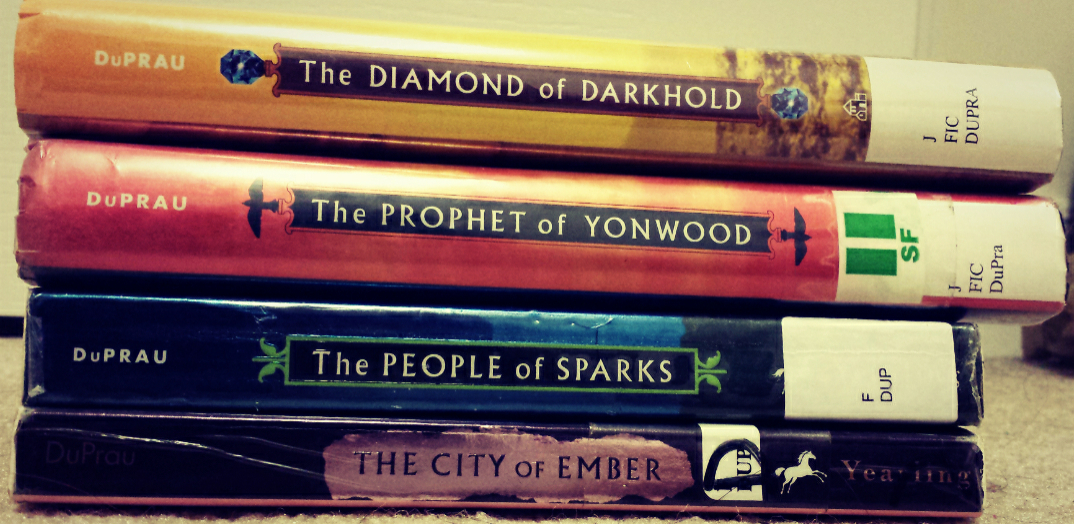
Jeanne DuPrau however, is a genius. With her The City of Ember Series, she not only captures the imaginations of young and adult readers alike, she uses her compassionate voice to galvanize our kinder selves. Here’s how:
Book#1: The City of Ember
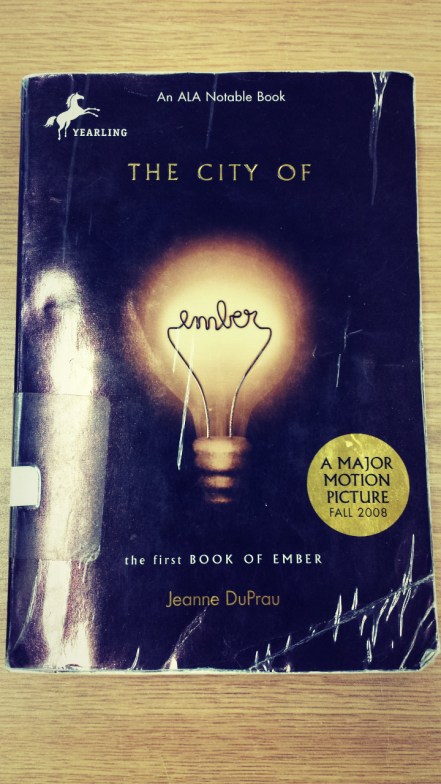
I happened upon The City of Ember, DuPrau’s first book, when one of my colleagues decided to do it as a novel study with his students. He meant to simply delve into the genre of Science Fiction with his class. A pilot project of a different genre, if you will. The result was not just his entire class yanking the books off every shelf to continue the series, but I too checked out this entire series from the local library.
This first book starts off with two very strong characters who find themselves partners in a journey to save their people, the Emberites, from total destruction. Young Lina is a fireball of energy and she has her conscience ground on tight. Young Doon has a few lessons to learn along the way, but he surprises everyone with his bravery at key points. The setting of the City of Ember unfolds a fantastic tale of an underground city built to survive destruction. The Emberites are not aware that they exist below the surface, they do not know what the sky or the sun are. Their daily existence is dictated by the timing of the floodlights that line their buildings and streets, lights that have been going on and off on schedule for nearly 200 years…until they start flickering. Can the people of Ember escape before the electricity that powers their daily lives gives out? Or will they be lost forever in an abyss of fatal darkness? This first installment explores themes of courage and perseverance. It explores themes of friendship and loyalty. It explores familial bonds and doing what is right. It explores our human need for survival even if severe risk-taking is the only option. This first book will leave you clamouring for the next three until the final, satisfying finish.
Book#2: The People of Sparks
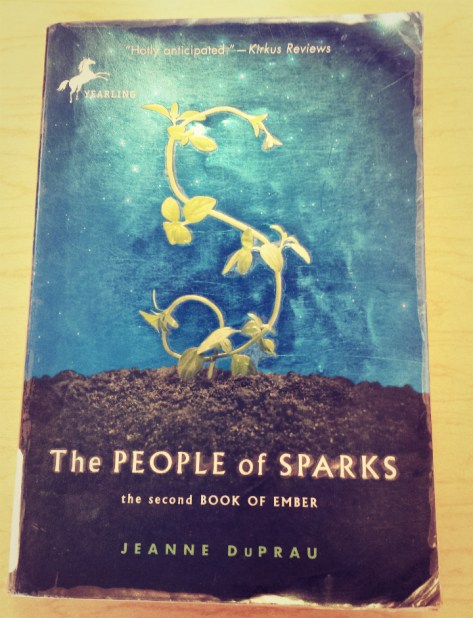
The second book in the series, The People of Sparks unveils what happens when different communities are forced to live side-by-side. It teaches readers of all ages the valuable lesson of how anger and violence can decimate relationships and entire societies. It promotes non-violence and peace, no matter how much hardship must be endured to find that peace. It brings forth the human desire for being good and giving good to our fellow human beings. However, it also shows our primal nature for self-preservation in the face of impending danger. Above all, it teaches the reader that there is a fine line between that choice, and making the wrong one can have catastrophic outcomes for all of mankind. Lina and Doon are back, but this time in a different place than their native Ember. This new world is strange and hard, but Lina and Doon, along with a whole lot of other characters are not crushed.
It is in this book, that the reader is made aware of the Great Disaster that nearly demolished all of mankind. Themes of human greed and kindness, wisdom and violence are explored with very compassionate conclusions. In many ways, DuPrau weaves morality and better ways of being into her books. And this is where her genius shines brightest, in her sensitivity to the evil that exists in our world, and her ability to find a way to take a strong stance against it. All this, with a non-violence the likes of Mahatma Gandhi. In this second book, readers are, or maybe just I was, moved to tears at the goodness of humankind. Cue #faithinhumanityrestored.
Book#3: The Prophet of Yonwood
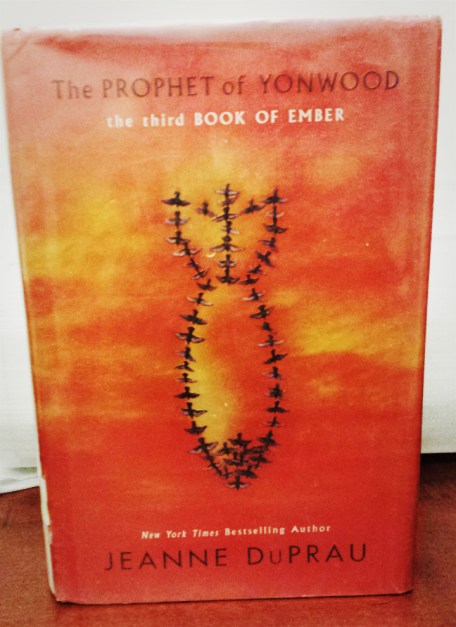
The Prophet of Yonwood is perhaps my least favourite of the series (if it is possible to have a least favourite in this series). It attempts to explain the existence of the riveting events in the first book, and guide along any predictions for the last and final book that the reader might have.
In this one a very flimsy story is built around a lady named Althea Tower and her “prophecies” as reasons for the way things are in a small town called Yonwood. We meet new characters in this book, because this one in chronological order, precedes The City of Ember and exists hundred of years before those events. Much of the story seems like a filler to explain minute details that I think the reader could have put together for him/herself with the help of a brief preface from DuPrau, in possibly the last book.
We meet the characters of Nickie and Grover, characters very similar to Lina and Doon in The City of Ember and The People of Sparks. These characters seem to slosh about in this book, biding their time until the very end when things are revealed to the reader. They plunge along sans meaning many at times, and they seem to know this as they take on bonds with animals to fill in their time in this book. Stories branch out of the woodwork and take on weak tangents before finding a quick and slightly bewildering path to an end.
However, this book is not all a waste of its 289 pages. It brings about the questions surrounding faith and how one comes to develop a sense of right and wrong. It is very profound in its exploration of this multi-faceted conundrum, and DuPrau manages to do this in a manner that does not patronize. The main character, Nickie, is plagued with her notions of what faith is and what is right and wrong in relation to what she believes and what other people tell her. Nickie trundles through the book and arrives a much-changed character at the end of the book where we see she has grown herself a strong foundation of morality and her own faith.
The question of the existence of God is put on the table, and even though much of this entire series has a strong Science-Fiction element to it, it is equally acknowledging and respectful of religion and faith. And this is one of the many things that makes DuPrau a must-read author. She offers always, both sides to the coin, not a biased version of just one perspective. In doing so, she positions her books in a very powerful position to help growing minds too, to see both sides to each coin.
Book#4: The Diamond of Darkhold
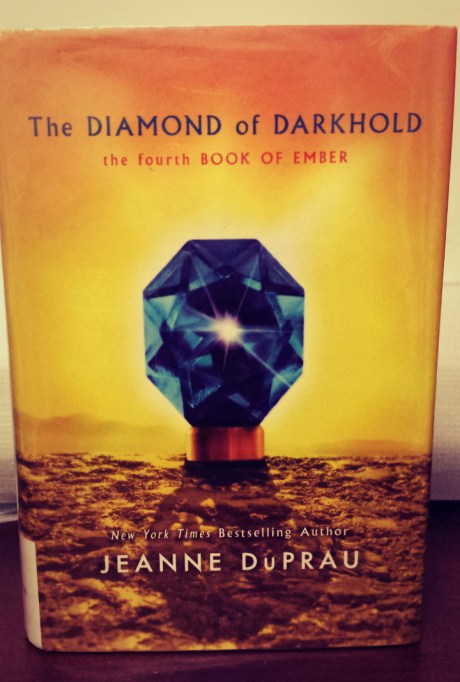
The Diamond of Darkhold is the final book in the series, and what a joy it is indeed! It brings full circle with absolute brilliance, the journey of not just Lina and Doon, but the entirety of humankind. The very final secrets are revealed, and humankind seems to find herself back to the very threshold of the powerful beginning when things were simpler and war and disease did not devastate.
The courage of Lina and Doon make a comeback in this book, but DuPrau has become braver and she has reckoned that so has her audience, and as a result she plunges her readers into terrifying depths with this last installment.
Selflessness and the desire to contribute in a meaningful way are two ideas that are thoroughly championed throughout this book. So is the very important concept of forgiveness. Lina and Doon risk their lives to help their people lead a better life, and in doing so provide hope for the future. In this book too, DuPrau gets more creative and technical in her understanding of various scientific elements, specifically Electricity. She champions solar energy and clean living, other lessons that I believe are crucial to growing minds everywhere.
All in all, DuPrau offers hope amidst a destroyed civilization, always with the caveat to be good to each other and not live greedily. As she paints the pictures of evil and destruction and hardship, she places in all her readers the knowledge that our existence (with our inventions and lifestyles) are but mere grains of sand that can be wiped out in the event of major catastrophes. Extremely fragile. DuPrau attempts to instill a humility in a society too plagued with the self and airs of entitlement.
Conclusion
Throughout the series, you will laugh with, and cheer on the main characters, Lina and Doon. You will grow to revere Doon’s father and Mrs. Murdock and develop a sibling-affection for little Poppy. You will even feel a fondness of Maddy, the at-first gruff, but finally gentle-hearted roamer. Jeanne DuPrau’s books seek to explore the human psyche and the forces of evil and good that bubble just below our surfaces. She experiments with different scenarios to determine which force will rise to the forefront at any given moment. And she does this without the jargon associated with many psychologists, both past and present. DuPrau allows us glimpses of our world’s outcomes depending on the decisions we make.
Until now, the only series that has really thrilled me has been Harry Potter by J.K. Rowling. However, in many ways, this gem of a series by Jeanne DuPrau has the potential to go even further in being, not just stellar literature for young children (and adults) everywhere, but purposeful reading that can seek to bring positive change to our world. This entire series is a MUST-READ for students at the Junior Level (Grades 4-6), so teachers, take note! It helps with their Citizenship Development, making them into more responsible leaders for our future. I vow to teach this to my junior students someday, but until then, these four books will be making their way to the shelves of my personal library.
© booksnnooks.org All Rights Reserved
 Books 'n' Nooks