Let’s Live with Gratitude, Dear World.

wp-1476040454749.jpeg

This is Thanksgiving weekend here in Canada, and having been deeply moved by the sermon at mass this morning, I found myself moving towards a post to share the same.

The sermon focused, rather aptly, on the spirit of gratitude. The priest began by sharing his own experiences of complaining about things in life when they don’t go his way. He acknowledged that as human beings we are prone to ingratitude and feelings of entitlement that lead us to believe that comfort and good things are due to us. As a result, when they don’t come our way as expected, we do not know how to react, cue an attitude of ingratitude. He emphasized that with such an attitude, it is impossible to live a fulfilling life. The cure he said? Switching out an attitude of ingratitude for one of gratitude. And how right he is. Being grateful for the positive in our lives and recognizing the value in the negative to help us grow, leads us to living joyful lives. Instead of whining about what is going wrong, why not think about all the things that went right? To keep with this spirit of spreading the message of leading a life of gratitude, I looked up (on Google IMAGES) a number of quotes, and a plethora of them is what I found. I am sharing some in this post because I think being grateful is something that may not come naturally to a lot of us, but it is something worth practicing everyday until it is natural. Being grateful will improve our quality of life. After all, it is only a matter of a change in perspective, a worthwhile investment that yields BIG dividends.

Ponder these then. They are beautiful.

This slideshow requires JavaScript.

P.S. To my readers all over the world, I thank you for visiting my humble website. If not for your loyalty, I wouldn’t post the things I do. XO.


©booksnnooks.org All Rights Reserved

Daily Gratitude: Ideas for Teachers

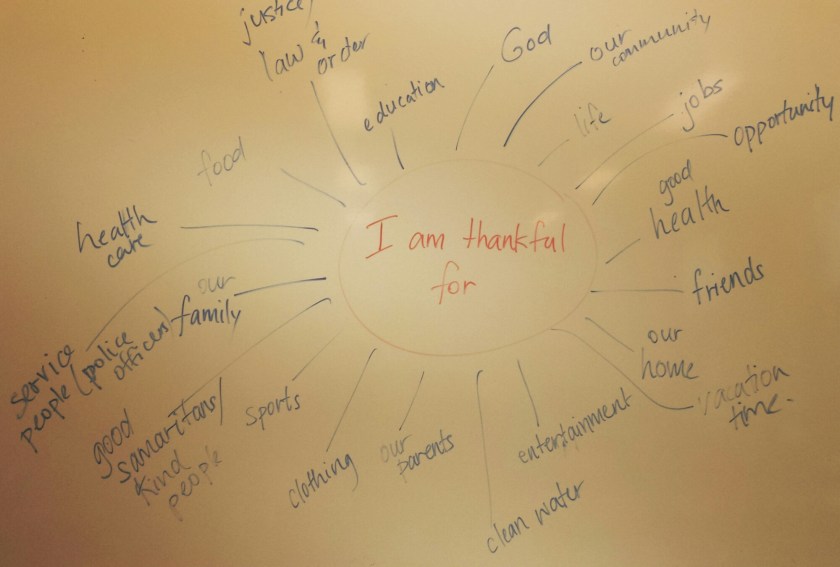
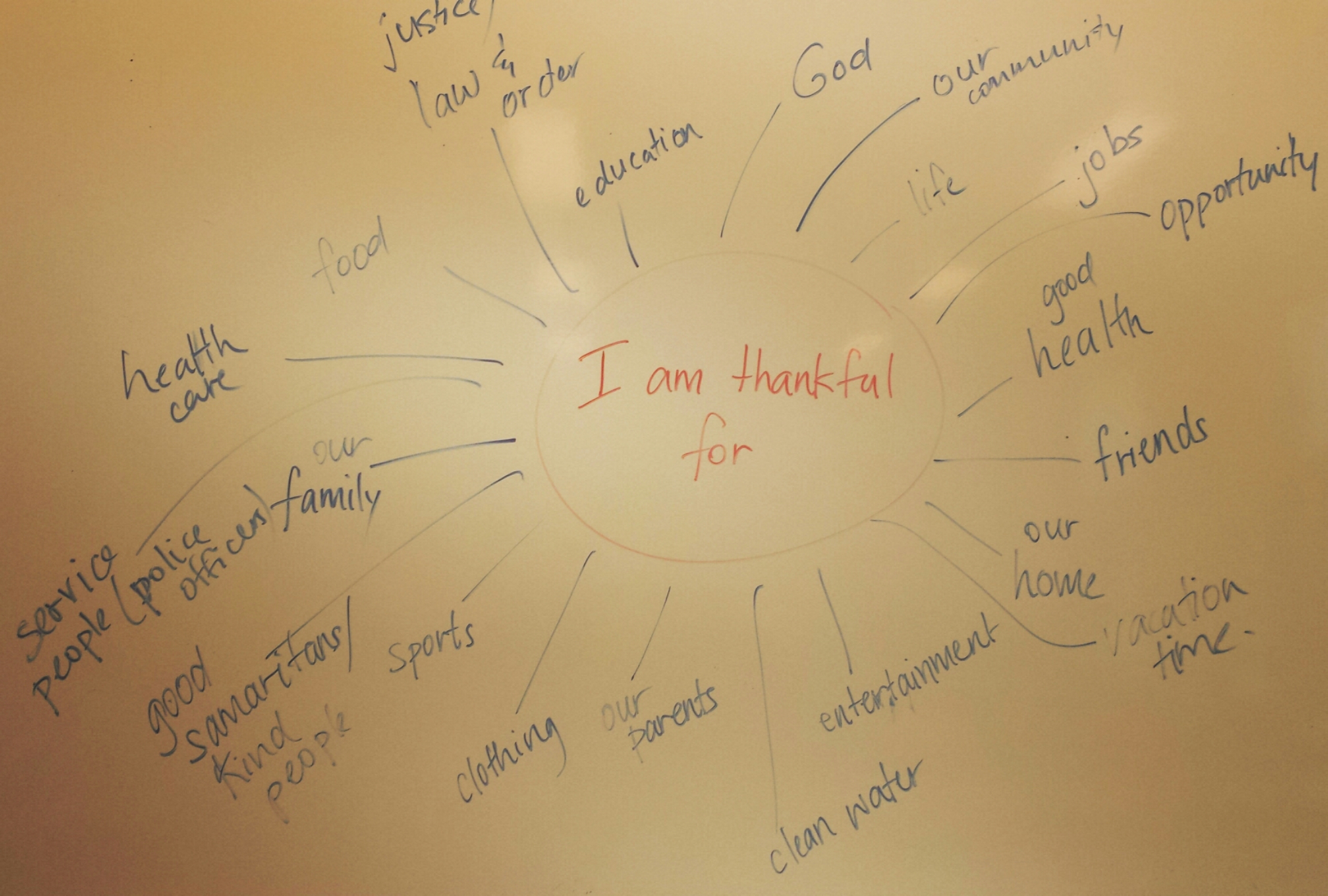
So, this month schools in the Catholic Board celebrate the virtue of Gratitude. Personally, I think it is a good idea to inculcate in our younger generation the concept of being thankful every day, however, having an entire month dedicated to this virtue is a good start. Today, I had the pleasure of leading a junior class to dig deep and find out what they were thankful for. This is what we came up with:
image

Initially, students threw out the tried-and-true: food, family, home, clothing, but then they began to really think about the concept of gratitude, and came up with being thankful for kind people and opportunities in life and our healthcare system(even if it isn’t perfect). This brainstorming session was done to help students prepare for a thanksgiving prayer they were to write. And while this is a great way to get your students thinking about what they are grateful for, it is not the only thing. Below, I have outlined some other ways to carry out activities to promote a spirit of gratitude in your students.

Other Ways to Incorporate the Spirit of Gratitude in Your Class:

#1 The “I am thankful for…” Display Board (Individual)

Set up a display board in one area of your classroom. Give it the title, “I am thankful for…” Each week, as a combined cross-curricular activity of art and writing (appropriate for all grades K-12), have each one of your students draw and colour and then elaborate (in writing – a sentence or just a word for the younger grades) on something they were thankful for that week. This activity can be done on the Friday so students have plenty of time during the week to think about what they can use. Remind students constantly during the week, if opportunities arise where they could be grateful for something, and have them bank these for later. Since artwork will have a weekly turnaround, have students make their own “I am thankful for…” folders (simple cream-coloured duo-tangs that they can decorate for an additional art activity). All work, once it is taken down from the display board, can be added to their individual folders for a keepsake of what they were thankful for that particular year. This could serve as a reminder when things are particularly rough in their lives and they are searching for positivity to get them through.

#2 Thank You Cards (Individual)

These are a practical and thoughtful way to reach out to others in the community and say a special thank you. Once a month (and this could be done in lieu of contributing to the display board idea above one week, if you choose to also do that), have students make THANK YOU cards. Each month they have to choose someone different whom they can say thank you to. Brainstorm with them different people in their lives they should be grateful to (parents, grandparents, siblings, other relatives, janitors, secretaries, principals, teachers, school crossing guard, their family physician, firefighters, police officers etc.). You could also have all the students make THANK YOU cards for different community helpers and then mail the cards to them, or drop them off if they are close enough. This activity also has the added advantage of serving as a dual art and language project and is appropriate for any grade from K to 12.

#3 Thank You Movie (Group Work)

This activity would best be suited for grades 5 and up, and would combine elements of multi-media, language, drama, art and so on. Students can create a movie choosing 5 (or fewer) different people in their lives that they are grateful for. They would then have to act out the roles these people play in their lives (students would have to agree as a group who these people will be – e.g. they would be parents in general and not specifically one student’s parents). They would film their enacting of these people’s roles in their lives and then combine technology elements (use iMovie, MovieMaker or other editing software they might be comfortable with) to add reasons why they are grateful for these people. Remind students to be respectful and thoughtful in their creations. Provide examples by repeating the above brainstorming activity as a class. Give students graphic organizers to record some of the ideas being brainstormed as a class. Allow them creative license to provide whatever twist on this project that they would like. Typically, allowing them a few weeks to put this together would be ideal.

And teachers, really, the sky’s the limit when it comes to teaching your students the virtue of gratitude. Let’s face it, we are educating quite an entitled lot these days, and a little bit of time taken to teach them valuable life lessons, would go a long way.


©booksnnooks.org All Rights Reserved


The Polacco Series: Gratitude

Some of you, and maybe a lot of teachers, might be familiar with the name Patricia Polacco. As educators, I think her books are essential components of our libraries. Polacco is a truly gifted author, who uses her life experiences and cultural heritage to write immensely touching books that, if you were being honest with yourself, border on a “tear-jerker”. Not only is this very talented author a moving writer, she illustrates her books with emotional sketches and tugging colours. I have done countless read-alouds with my students where we discuss her choice of colour for specific artwork, coming to the conclusion that like her words, her drawings are also bursting with meaning.

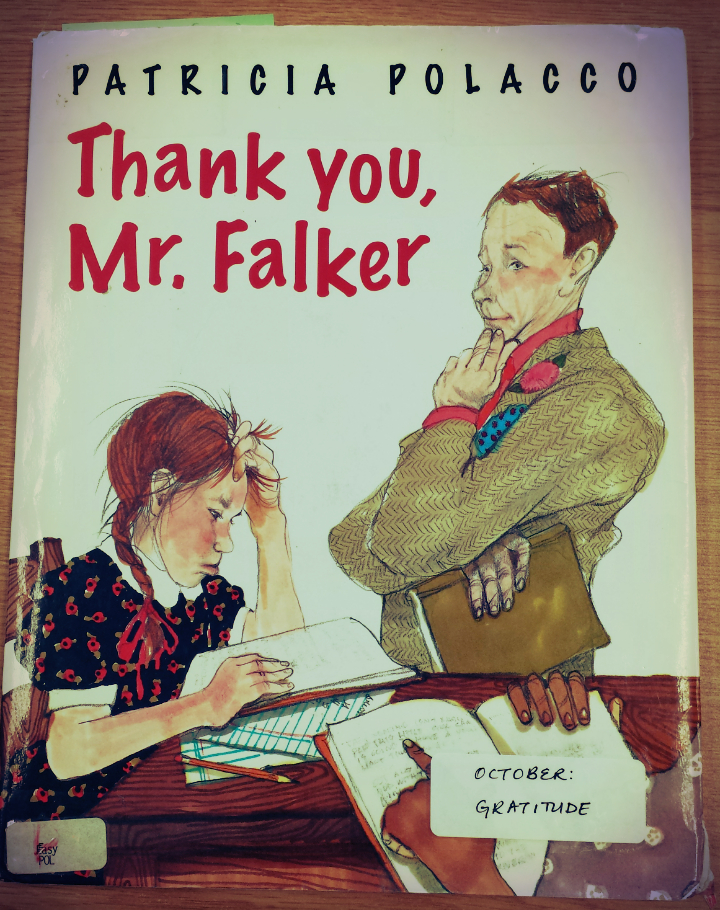
One of my favourite books from Polacco is the ADORED Thank you, Mr. Falker

This book weaves a heart-rending story of a young girl, Trisha, who faces challenges in her learning. She has dyslexia, and none of the teaching staff at her school are able to pick this up. This challenge makes our young protagonist a target for name-calling and bullying. And, unlike other children, when Trisha welcomes the chance to move to another city and start over at a new school, her hopes are met with despair, as she painfully navigates yet another school system stuffed with bullies and teaching staff who do not seem to care. Until of course she meets Mr. Falker. Mr. Falker, like a lot of teachers these days who get into teaching despite its hardships, is the teacher who makes a difference in this girl’s life. He takes a gamble on her and his gamble pays off, leading to a moment, brilliantly narrated with emotion, that changes Trisha’s life forever. Based on a true story, this narrative is packed with feel-goods.

Perfect for  grades 3-6, and abounding in themes of gratitude, compassion, bullying awareness, self-confidence issues in children, learning challenges and their effects, this book should really be read to every child out there. If nothing else, it lets children know that they are not alone in their struggles, and that they can rely on that one teacher to make a difference in their lives.


©booksnnooks.org All Rights Reserved
Picture Book Spotlight: A Slight Change in Perspective

Let’s face it then, in today’s world with messages about the way we should act and dress and talk and smile, children don’t really have a fighting chance to decide who they are and love themselves for it. There is so much pressure on our little ones today, that it is a wonder not all of them break under it. Little girls as old as 5 are wearing makeup…trust me, there is a lot wrong with that. And while that is in itself a discussion for another blog, I would like to talk about a Picture Book (Because let’s keep true to the main obsession of this blog, right?) that does a lot of good in helping children understand their own worth, and taking them on one of their first steps to loving themselves. All this with a slight change in perspective.

Amy Krouse Rosenthal is a gifted Children’s Author, and today I want to profile my favourite book from her collection: Spoon. Spoon is a book about…you guessed it, a spoon. A spoon who feels that he is not as special as the forks and the knives and the chopsticks of the world. He ambles on feeling sorry for himself and pining away at the special qualities that his other kitchen folk posses. Until, of course, a slight change in perspective helps him appreciate what he is.

Rosenthal uses the simple, yet profound analogy of being a spoon, to help children understand that each of them is special as (s)he is. With all the conformity inherent in our world, where being part of the pack is championed, the outliers don’t often have the chance to offer their special talents to our world. Rosenthal tries to help with that. Replete with illustrations that tickles a child’s imagination, and dialogue that brings spoons everywhere to life, this book offers children the rare opportunity to see the world differently in any situation, if they just learn how to change their perspective. It offers an option to put a positive spin on just about anything that might look particularly dire. Children have the chance to learn how to be grateful for what they have and who they are. And gratitude is much needed in a world bursting at the seams with entitlement.

So, if you’re a primary teacher, a parent of a child between the ages of 4 and 8, this books MUST be on your shelf. Who knows, that child sitting in the corner in the back of the room, might have his world turned to a shining view after you’ve read this one out loud!

© booksnnooks.org All Rights Reserved