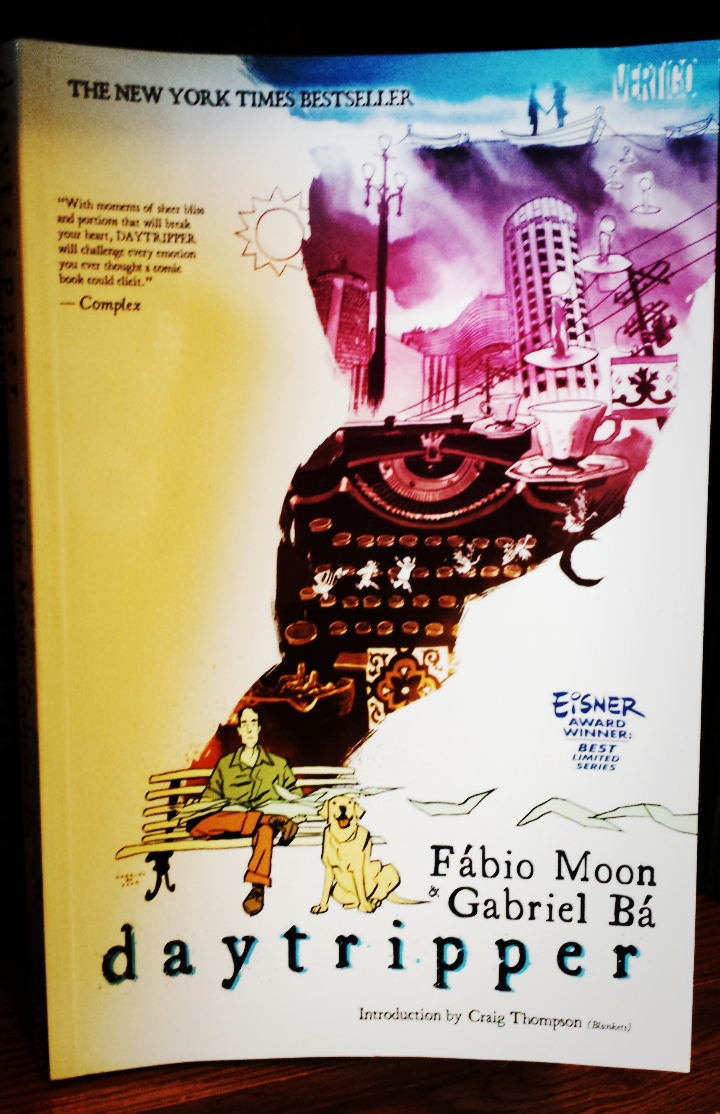
daytripper: A Graphic Novel

I am a fan of the graphic novel form. There is much, as I have addressed in previous posts about the graphic novel, to be learned from this relatively new way of combining writing and art. So, when a good friend recommended that I read daytripper by Fabio Moon and Gabriel Ba, I did not need much convincing.

Rating: 4.0/5.0

Set in Brazil, this story is structured in the past, present and future. It revolves around the life of Bras de Oliva Domingos. The novel is sectioned into chapters, each chapter a different year in Bras’ life, and each chapter ends with Bras’ death. Perhaps, this is a way to show the reader the different possibilities inherent in a life and how as easily as we can begin new things, these things can also come to unexpected ends.

When I began reading this graphic novel, I thought the situations too contrived, the dialogue and captions too scripted. Some things felt forced. However, I trudged on. I reasoned that maybe I was missing the point; putting too much emphasis on style and not enough on sentiment. Three-quarters of the way into the book, I realized I was gripped, and barreling toward the finish to conjure a stable understanding of the novel. I will admit that this book is very cleverly structured. Bras is presented at different points in his life, and with each new point, we are given a new perspective on who he is as a person and his relationship with the other characters in the book. Each chapter fills in pieces left open by the previous chapter, amounting to a big jigsaw puzzle that also requires the reader’s perspective and contemplation to come into a fully-formed picture.

What I most enjoyed about this book was the artwork. The artwork carries a depth that paints this story in a more ‘real’ light. The characters’ aches and sadness, their joys and misgivings, their weaknesses and baser natures, are exposed in gestures and expressions, all adroitly captured in stunning visuals.

Covering themes of family, death and the fragility of life, achieving dreams, lost dreams, the art of writing, being a writer, developing a sense of self, friendship, love, parenthood and all the messiness in between the day-to-day of our collective lives, this graphic novel does surely leave you thinking about the brevity of our existence and perhaps the purpose of our lives. Lovers leave, family members die, friends abandon, dreams fall through, crises take over and doubts creep into the mind, but love finds a way to blossom and leave a hope that pulls the characters through.

This book merits a few readings, and not just to better understand what the talented twin-brother duo of Fabio Moon and Gabriel Ba are trying to convey, but also just to admire the artwork and appreciate that life is lived with a better understanding, when presented with the concept of purpose and then finally, death.

If you’re up for something different, I would say, give daytripper a try.


©booksnnooks.org All Rights Reserved
 

Championing Graphic Novels for Classroom Teaching

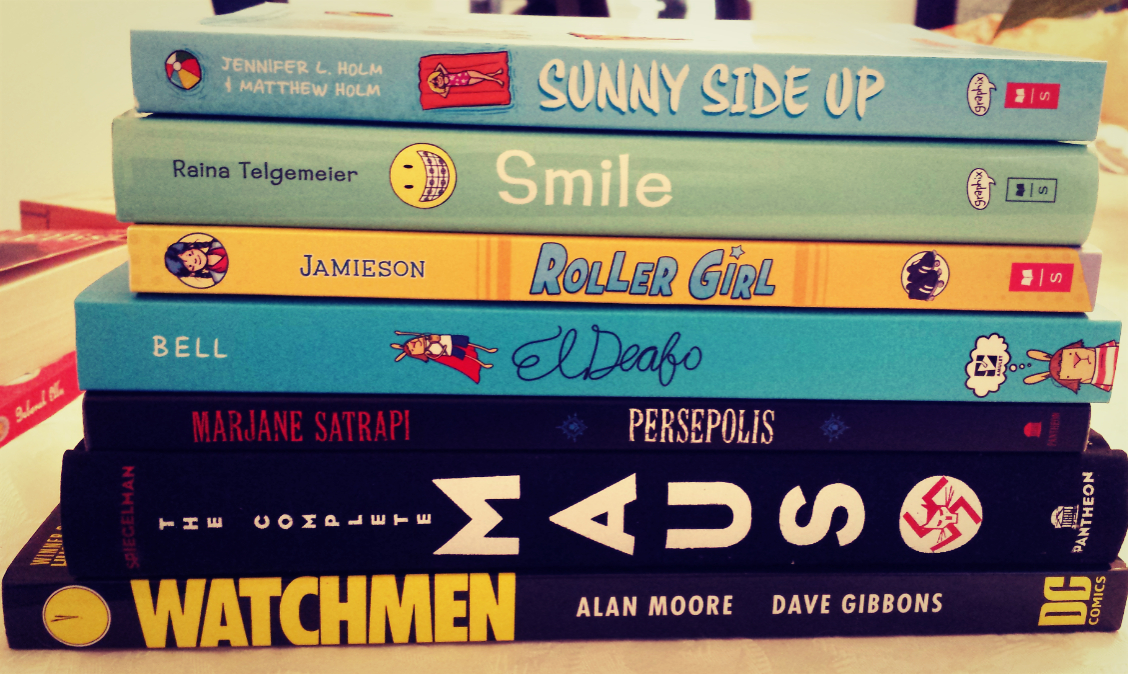
Some of my favourite graphic novels; great for teaching students Grades 4-12

As teachers, we like to revert to the tried-and-true classics when doing Novel Study Units, and teaching our students various bigger life themes. The likes of To Kill a Mockingbird, Inherit the Wind, The Great Gatsby, The Apprenticeship of Duddy Kravitz, Jane Eyre, The Importance of Being Ernest, Brave New World, 1984 and then of course those by the Great Bard, for the intermediate and senior grades. Trust me, I’ve done a good number of these in High School. And then there are the likes of Bridge to Terabithia, Freak the Mighty, Charlotte’s Web, Chronicles of Narnia for the junior grades.

Now, let me pose this question: Have you considered a graphic novel for your Novel Study Unit? I have talked to a lot of teachers, especially in the junior and intermediate grades, and they are incredibly distrusting of the graphic novel. It is viewed by many teachers as a medium of entertainment, and not learning, for their students. Granted, there are graphic novels out there that are created with the sole intent of entertaining, but a lot of incredibly clever graphic artists and writers, collaborate to produce thought-provoking and striking graphic novels.

I would like to make a case for the teaching of graphic novels in grades across the board. I believe they have much value to add to our students’ learning. First of all, graphic novels are not just about the pictures. They are about the relationship between text and image. They are about the meaning in between the panels and the way the characters are drawn and coloured. They are about what is omitted and what is included. They are about meaning and form at their very core. However, they are also incredibly accessible. Graphic novels have the power to engage students who are not willing readers of the traditional text. They have the know-how to capture this audience and potentially turn them into readers. Now, teachers, would that not be a cause for celebration?

Graphic novels further ignite creativity, they inject perspective and then offer other viewpoints contrasting with that first perspective. Art is introduced in an appealing way to students who might not necessarily find themselves drawn to it. The graphic novel has the unbridled power to marry different forms of expression to achieve greater meaning.

Several graphic novels written over the last few years have sought to take big risks and tackle radical topics. Sunny Side Up by the Holm brother and sister duo (Fear not, I shall review this one in time), El Deafo by Cece Bell, Persepolis by Marjane Satrapi, Maus by Art Spiegelman and Smile by Raina Telgemeier (a handful of my favourites) are some of the graphic novels that have burst out onto the scene and made an impact. From tackling big issues of substance abuse to identity and war in Iran, from physical disabilities to World Wars and the struggles of adolescence, these books, and others, have the power to change thinking. They have the power to begin passionate discussion among students. So, teachers, pray tell, do they not deserve a ranking among the greats? Just because they are “newer” and “different” does not make them unworthy of being entered into the canon of literature-teaching tools.

One of my personal favourites is Watchmen by Alan Moore. This masterpiece makes the movie look ridiculous because, within its pages, it houses depth of meaning and form. It catapults the reader into the story and pulls the narrative around that reader-creator relationship.

Graphic novels are not just quick books that you can read on a trip from Toronto to New York City. They are fast becoming vehicles in which to express explosive thought. So teachers, what say you? Give the graphic novel a chance?


©booksnnooks.org All Rights Reserved


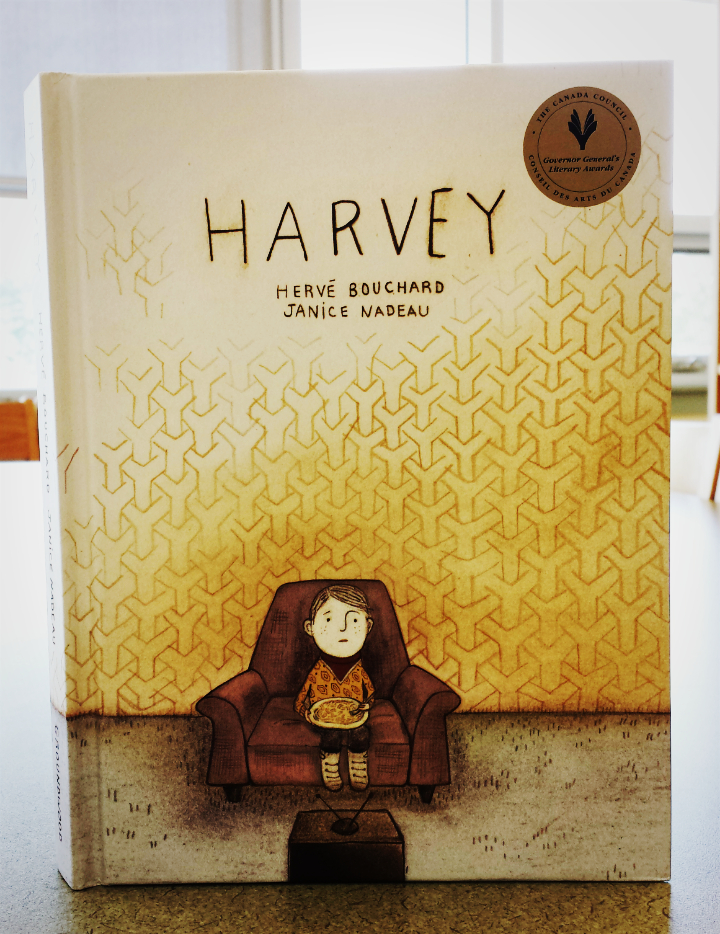
Harvey: A Simple, Yet Artistic, Account of Loss and Grief

Rating: 5/5

Let me begin with a warning that today’s blog discusses a concept that makes many of us grimace with pain. Death. Five letters that can quite literally shatter our lives. When I came across this book by Hervé Bouchard and Janice Nadeau, I was both deeply moved and in awe.

Harvey, written by Hervé Bouchard and illustrated by Janice Nadeau is a project that truly synchronizes illustration with text. And with that segue, I will begin with the technical elements that make this book a gem to own. When I think about categorizing this book, I am unsure whether it falls within the realm of picture book, it is a bit too long for that, graphic novel, while it does have graphic illustrations and real-time dialogue(minus the speech bubbles) it is missing the characteristic panel-structure of graphic novels, or junior novel, the subject matter and the textual length and level seem to offer signs of this. I then came to the conclusion that it really is all 3: picture book with a hint of graphic novel and junior novel.

Now, the subject matter focuses on the death of our main character, Harvey’s, father. Harvey and his brother, Cantin, live in Quebec, and on their way home from school one Spring day, find an ambulance and a crowd of people outside their home. A stretcher holding a blanketed figure is brought out of their house with their mother wailing behind. Then, a key set of events is set off in slow motion as our writer and illustrator quite dexterously capture the grief inherent in loss. A child often processes the loss around death differently than an adult. And while the stages of grief are similar for more or less all of us, children often are left confused and filling in the  gaps that a loved one’s demise has created. There is the knowledge of loss, but pieces of  life seem to move out of kilter, with a child having to struggle to return to some semblance of normalcy. Harvey processes his loss in a very practical matter. He lays out the facts and then follows through on what must be done to deal with his father’s death. His younger brother, Cantin, however, takes a different route when dealing with his loss. His reaction is more emotive. Harvey is the older one of the two and perhaps this difference in reaction is in part due to age and maturity. I would argue though that loss affects us all differently depending on our different personalities. The matter-of-fact text that Bouchard uses to explain the progression of events gnaws at your mind and heart. Nadeau is exceptionally  clever with her use of colours and lines and spaces. She employs darker, smudged-out, and consistently  faded and ragged colours to convey the heaviness of loss. A “grayness”, both of feeling and colour, hover over throughout the book. I don’t normally tout the illustrator of the picture books I review, but that is usually because the text stands out more to me. In this book, Nadeau’s illustrations take the cake. She is superbly talented in conveying the gravity of emotion and state of mind that someone dealing with loss encounters. And it is this talent of hers that I believe renders this book a masterpiece.

Winner of the Governor General’s Literary Award, this book is a gentle reminder of death looming in lives. It offers a raw interpretation of loss suffered by a child and in doing so, makes us as adults more keenly aware of how we can better support our young ones through such a difficult process.


© booksnnooks.org All Rights Reserved