Daily Gratitude: Ideas for Teachers

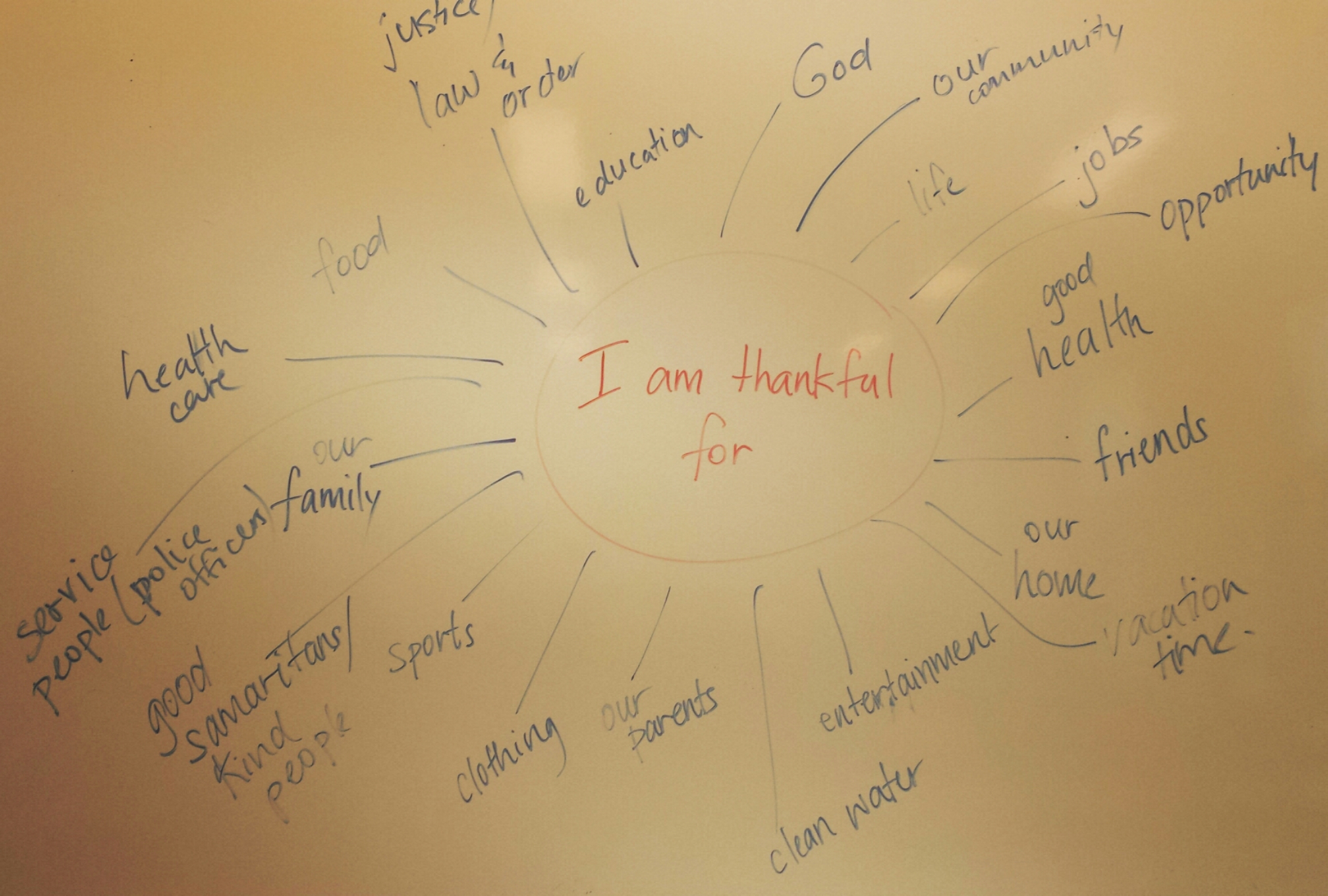
So, this month schools in the Catholic Board celebrate the virtue of Gratitude. Personally, I think it is a good idea to inculcate in our younger generation the concept of being thankful every day, however, having an entire month dedicated to this virtue is a good start. Today, I had the pleasure of leading a junior class to dig deep and find out what they were thankful for. This is what we came up with:
image

Initially, students threw out the tried-and-true: food, family, home, clothing, but then they began to really think about the concept of gratitude, and came up with being thankful for kind people and opportunities in life and our healthcare system(even if it isn’t perfect). This brainstorming session was done to help students prepare for a thanksgiving prayer they were to write. And while this is a great way to get your students thinking about what they are grateful for, it is not the only thing. Below, I have outlined some other ways to carry out activities to promote a spirit of gratitude in your students.

Other Ways to Incorporate the Spirit of Gratitude in Your Class:

#1 The “I am thankful for…” Display Board (Individual)

Set up a display board in one area of your classroom. Give it the title, “I am thankful for…” Each week, as a combined cross-curricular activity of art and writing (appropriate for all grades K-12), have each one of your students draw and colour and then elaborate (in writing – a sentence or just a word for the younger grades) on something they were thankful for that week. This activity can be done on the Friday so students have plenty of time during the week to think about what they can use. Remind students constantly during the week, if opportunities arise where they could be grateful for something, and have them bank these for later. Since artwork will have a weekly turnaround, have students make their own “I am thankful for…” folders (simple cream-coloured duo-tangs that they can decorate for an additional art activity). All work, once it is taken down from the display board, can be added to their individual folders for a keepsake of what they were thankful for that particular year. This could serve as a reminder when things are particularly rough in their lives and they are searching for positivity to get them through.

#2 Thank You Cards (Individual)

These are a practical and thoughtful way to reach out to others in the community and say a special thank you. Once a month (and this could be done in lieu of contributing to the display board idea above one week, if you choose to also do that), have students make THANK YOU cards. Each month they have to choose someone different whom they can say thank you to. Brainstorm with them different people in their lives they should be grateful to (parents, grandparents, siblings, other relatives, janitors, secretaries, principals, teachers, school crossing guard, their family physician, firefighters, police officers etc.). You could also have all the students make THANK YOU cards for different community helpers and then mail the cards to them, or drop them off if they are close enough. This activity also has the added advantage of serving as a dual art and language project and is appropriate for any grade from K to 12.

#3 Thank You Movie (Group Work)

This activity would best be suited for grades 5 and up, and would combine elements of multi-media, language, drama, art and so on. Students can create a movie choosing 5 (or fewer) different people in their lives that they are grateful for. They would then have to act out the roles these people play in their lives (students would have to agree as a group who these people will be – e.g. they would be parents in general and not specifically one student’s parents). They would film their enacting of these people’s roles in their lives and then combine technology elements (use iMovie, MovieMaker or other editing software they might be comfortable with) to add reasons why they are grateful for these people. Remind students to be respectful and thoughtful in their creations. Provide examples by repeating the above brainstorming activity as a class. Give students graphic organizers to record some of the ideas being brainstormed as a class. Allow them creative license to provide whatever twist on this project that they would like. Typically, allowing them a few weeks to put this together would be ideal.

And teachers, really, the sky’s the limit when it comes to teaching your students the virtue of gratitude. Let’s face it, we are educating quite an entitled lot these days, and a little bit of time taken to teach them valuable life lessons, would go a long way.


©booksnnooks.org All Rights Reserved
 

Extending The Great Kapok Tree by Lynne Cherry

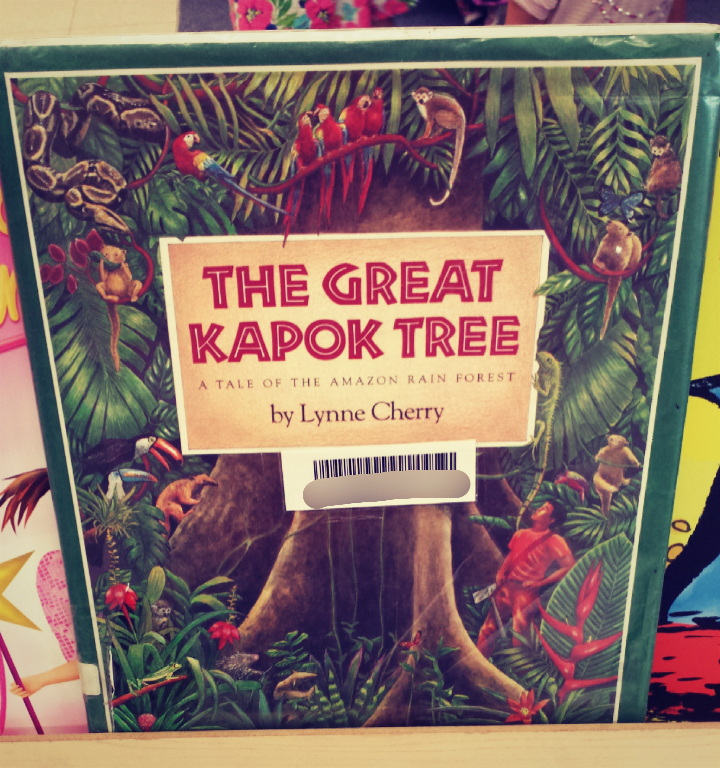
So, this time I have given it all away in my title. I will be writing about how The Great Kapok Tree by Lynne Cherry is a FABULOUS resource for teachers as a read-aloud, and how to extend this book in at least one (very fun) way.

I have read this book several times now, and have developed a pattern for when to ask what questions and how to get the most out of it. Cherry has masterfully crafted a book where young children are walked through the process of recognizing the importance of nature, step-by-step. The book opens with GORGEOUS illustrations depicting the Amazon Rain Forest. Teachers, you can easily do an introductory lesson on geography, and get your students to look up where the Amazon Rain Forest is located, and develop a sense of the setting in this book.

The reason I like this book so much is because it breaks down the benefits of nature and the importance of preserving it, page by page. Students can also widen their knowledge of flora and fauna through the pictures of birds, animals and plants that they see. You see toucans and sloths, monkeys and anteaters, jaguars and macaws, and your students will LOVE identifying and learning about these animals.

Various concepts you can touch on briefly or extend in detail are: camouflaging, the role of trees in providing oxygen, the importance of preserving trees for future generations, the food chain, animal habitats etc. This book is a FANTASTIC jumping platform for other concepts that you want to introduce to your class. Typically, I have read this to grades 2 and 3, but this can be stretched to the lower junior grades as well, 4 and 5.

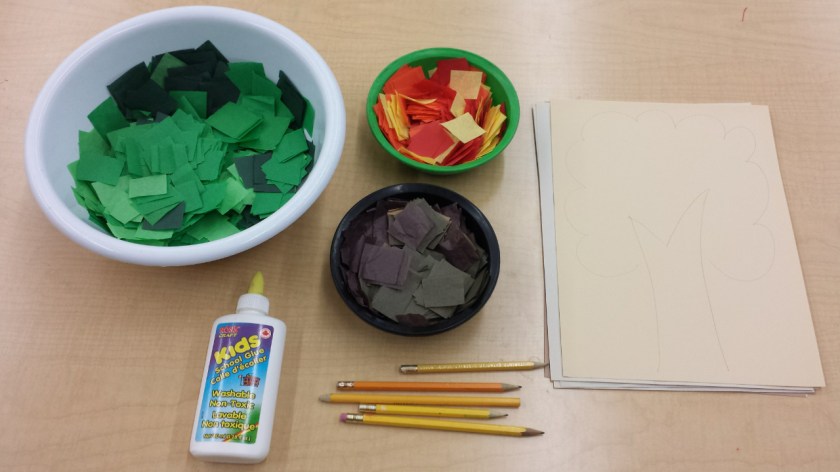
A great extension activity that we used to avail of the wonderful cross-curricular opportunities this book offers, was doing an art project with tissue paper. We used cut-up tissue paper in different tree-colours to make trees. I further encouraged my students to note down in one word or phrase, the importance of trees to emphasize the literacy component of their learning, and to help with summarizing skills.

The following materials were used:

wp-1468460188165.jpeg
For this project you will need tissue paper of yellow, red and orange, and different shades of green and brown, cut up into neat little squares, glue, pencils and blank sheets of paper with tree outlines drawn on.

I took a video to best illustrate the process, as below:

And here are some finished products. Such artists the kids are!

This slideshow requires JavaScript.

So what are your waiting for? Go on! Give this INCREDIBLE book a read aloud and then do this COOL activity. You will convert even the most inattentive and hard-to-manage student in your class, as (s)he sits down quietly and completes this (almost) therapeutic project. Happy art-ing! And, you’re welcome.

©booksnnooks.org All Rights Reserved
Art for Therapy: The Benefits of Unleashing Your Creative Side

In the last little while, art has been gaining more traction in contributing to society on a significant level. I don’t just mean paintings or sculptures the likes of Rothko, Degas, Kahlo, Matisse, Savage, Morrisseau or Carr, in galleries that people ooh and ahh over, but a myriad of art pieces created by non-professional artists like you and I. Now, some people might shy away from being branded an artist, and that’s okay because we might not necessarily subscribe to the pressure associated with being a creative person. However, by the very nature of creating something resembling art (and I know the word “art” can be interpreted very loosely depending on your perspective), would that not make you an artist? Or at the very least creative?

Artists are special people; their minds work in different ways. Creative people in general have the ability to look at things from different angles, and maybe this flexibility in perspective is what renders the therapeutic aspect of art. It can act as a catharsis for the stresses of this life, and I know this first hand because I am at my happiest when I am being creative: making something with my hands or mind. This making could be the creating of a meal or a crochet project, greeting cards or sketching, photography or even colouring. Yes, colouring, that thing we did with those bright and pointy nibs when we were younger. It has been making a comeback lately, and the marketing suits have a solid reason to push it. Psychology is on their side.

Colouring books adorn the shelves at Indigo, Chapters and Coles. And there are various themes for whatever you’re into: Harry Potter Fan? Animal Enthusiast? Japanese Pattern Lover? There’s something for everyone. Including me! I was at Costco the other day and until now, I haven’t tapped into the colouring frenzy, mostly because I haven’t found a theme that appealed to me. And then, voila! On a neatly-stacked line of books, there was this:

The Shine: Color your life beautiful theme is teeming with Biblical quotes that provide hope during trying times. It is resplendent with nature motifs that seek to calm your nerves as you fill in the colours from your mind’s eye. I had a very trying week, and one day I made it a point to choose and colour a page (below). An hour and half of uninterrupted colouring later, I felt different. I felt like I had taken a power nap and woken up energized and clean of my mental stressors.

img1463620800613.jpg

Now, colouring might not prove therapeutic for the non-artist, but I do think there is something in the very action of repetition (rubbing a pencil crayon back and forth across the paper), concentration (making sure the colour doesn’t come out of the lines) and un-pressured creative choice (the opportunity to pick whatever colours and shades you think best suit the picture before you) that makes colouring a strong contender in the realm of Art Therapy. I’ve seen the same stress-relieving benefits to crocheting; the looping of the chain with the same single and double knot motion through the entire piece to create something functional and noteworthy.

Specifically, I think engaging in arts and crafts has the ability to unlock the shackles to our day-to-day must-dos. For awhile, it pulls us back into a state of suspension where our creativity is activated. And that creativity, which utilizes a different part of our brain, can allow for us to tap into our happier selves.

Would I then recommend colouring as a form of relieving stress? Yes, but it doesn’t just have to be colouring. I would recommend any form of art, including the pillar of this blog post: writing.


© books ‘n’ nooks. All Rights Reserved