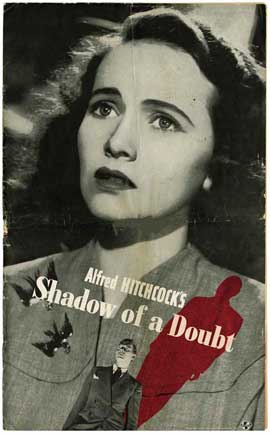
Charlie Newton: Hitchcock’s Female pièce de résistance

On a Hitchcock roll here.

His 1943 Shadow of a Doubt was a psychological cocktail that I indulged in this weekend. I have watched  a handful  of movies from the 1940s, and not many of them showcase a particularly strong female. The leading ladies are abuzz with character (quite possibly just hysterics) in most cases, but tend toward the demure and genteel when push comes to shove.

Not so for Teresa Wright’s character of Charlotte “Charlie” Newton. The movie opens with a zoom-in of a window of a room in the neighbourhood of a town. A man is being chased by a pair of men. The scene cuts to a young girl on a bed, philosophizing about life and the sheer lack-lustre-ness of it all. This is  young Charlie who is named after her maternal Uncle, Charles “Charlie” Oakley. Charles Oakley is the man on the run, but from what? He sends a telegram to his sister saying he is coming for a visit. His sister, ever the naive and doting-on-all-she-loves woman, is thrilled to be reconnected with her brother.

Charles arrives and Charlie’s mood is lifted. Only briefly. She soon catches whiff of something sinister cooking within her uncle. As characters thither about in their roles of sister and husband and friend and detective, Charlie is paying the keenest of attention to her uncle and his odd behaviour. There is a murderer of widows on the run in her country. Is he her uncle?

This Film Noir is marked by moments of psychological twisting as Charlie is first painted as a potential love interest of Charles Oakley’s. The subliminal acts of holding her close and slipping a ring (which is a gift) on her finger border on the verge of incest. However, just when you become uncomfortable with the notion of an uncle being interested in his niece and vice-versa, a love interest for Charlie is introduced, and Charlie herself steps up her game.

She goes from doting niece to shrewd sleuth. She battles numerous dangerous situations and comes out alive. She is portrayed as protector of her mother and family, fiercely determined to venture into uncertainty just so she can uncover the truth. She threatens her uncle with death, and is quite adept at handling herself with grace and coy around men interested in her wit and charm and beauty. Charlie Newton is easily one of Hitchcock’s best leading characters. She has spunk, determination, smarts and grace. And all this packed into a classy slim-waisted dress on heels. It is important also to note the symbolism behind Charlie’s name. She is given the nickname of a boy, but she posses all the wherewithal of a respectable woman. She is portrayed as a character with many angles, all quite fascinating. Further, she is named after her uncle, but she is presented as an alternate “good” version of his character. All this, not bad for an early 1940s leading lady. Hitchcock has proven yet again that he was a master at making a movie that comprises varying levels of psychologically-acute layers, while injecting social issues of the times.

Teresa Wright, for her part, juxtaposes quite well her expressions of fear with grit and ability. Her character walks right into traps in the name of respect and obligation, but walks right back out when she is confronted with someone wanting to take advantage of her perceived vulnerability.

This movie utilizes dark and light to balance quite nicely the themes of crime committed by a man whose heart is ashen with his diabolical thoughts, and a young lady on the brink of womanhood who is bursting with life and wisdom and adventure.

Hats off Hitchcock, this one was spectacular.


©booksnnooks.org All Rights Reserved
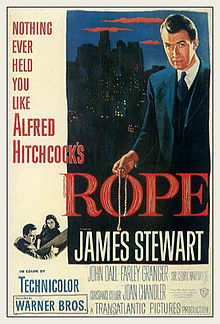
Hitchcock’s Rope: Philosophical and Gripping

My fascination with Alfred Hitchcock began years ago when I was little and would watch his movies with my parents. I have to admit, at the time, I didn’t grasp a lot of what was being enacted before my eyes, but now in my young adulthood, I am revisiting Hitchcock’s movies, and I have got to say, his genius is still relevant today.

I recently watched the movie, Rope. This 1948 film stars my favourite actor from that generation, James Stewart. Now, if you’re thinking that name rings a bell, you have likely seen him in the holiday classic, It’s a Wonderful Life. James is a superbly talented actor and a timeless one at that, but that is for another day and another blog post.

This movie opens with two of our lead characters, Bernard and Philip, strangling their friend, David, to death. The romantic philosophy of being superior beings collaborating in the masterful art of murder is touted as their raison d’etre, and their reason for committing this heinous act. This philosophy as we learn, has been first espoused by Nietzsche and taught by their college professor, Rupert (James Stewart). The duo then proceed to hold a dinner to “celebrate” this “achievement”. As the guests arrive, we see a very different aftermath play out with the two characters. Bernard is presented as the callous and charismatic psychopath, and Philip is really losing his  marbles with guilt. Enter their college professor, Rupert,  and the evening’s events begin to unravel themselves.

As is his signature trademark, Hitchcock very dexterously incorporates subtle angles in his filming that seek to foreshadow what is to come. The symbolism inherent in the various acts carried out by the characters in this movie, is exceptional. In one scene (AND SPOILER ALERT), Bernard is packaging a collection of First Edition books for the dead man’s father to take home, and he uses the same rope he killed his son with, to tie the books together.

I particularly enjoyed this movie because it got me thinking about society and the hierarchy of beings when it comes  to differentiating between superior and inferior. We see this as a recurring trend today with killings the world over, perpetrated by those holding twisted versions of concepts surrounding race or religion or gender. Friedrich Nietzsche’s Ubermensch or “Superman” philosophy is at the heart of this idea, where he essentially tosses out the concept of Godly values, in favour of an alternative system of values created by those who view themselves as superior to their fellow human beings. Bernard is that character in Rope. With his inflated sense of self, he rests content in the fact that he has carried out the perfect artistic venture to prove his superiority. However, as the movie hurtles towards its inevitable conclusion, all is not what it seems.


©booksnnooks.org All Rights Reserved

Miles Teller: The Essential Ingredient for Today’s Rom Coms

So, if you haven’t heard of Miles Teller, shame on you.

No really, are you not a romantic comedy fan? Do you live under a shoe (rocks are overrated)? Do you not have Netflix?

I have to confess. I have fallen for Miles Teller since I saw my first movie with him, Two Night Stand. This movie, featuring a strong female character, showcased a sincere and quirky Miles Teller in the Quintessential Rom Com. Except, his rom coms are clever. They have the edge of sharp wit, sarcasm and an extra dose of delightful eye-candy. They are your run-of-the-mill boy meets girl, falls in love with girl, stumbles into climactic conflict, and barrels toward a happy ending type. However, Miles packs on a lot of charm. He reminds me of a younger version of John Cusack. John Cusack, also a HUGE favourite of mine, possesses a very similar sense of sharp wit and sarcasm AND eye-candy. Don’t judge me, I like my eye-candy. As a result, I think Miles Teller should be an essential component of Romantic Comedies going forward. I mean sure, add the odd Zac Efron or whatchumacallhim, but keep the classic basic, Hollywood.

In Teller’s case, the roles in his movies seem to be written for him. And it is no wonder that they are quite similar. Now, maybe a case can be made that he is only great for such roles as those in That Awkward Moment, Spectacular Now and Get a Job (I am on a Miles Teller Marathon), however, admit you must, that he is great at them. Personally, I would rather a Master of one trade than a Jack of all.


©booksnnooks.org All Rights Reserved