In Conversation with Noam Chomsky: Requiem for the American Dream

I’ve always loved watching documentaries, and having someone who enjoys it just as much as I do makes the process entirely enjoyable. This weekend we sauntered off on a lazy morning walk in the rain, and after the obligatory Spiced Pumpkin Latte, we headed to the library. Among the titles of DVDs we picked out to pass our weekend was Requiem for the American Dream, and boy what a treat.

Presented by Noam Chomsky and informative and kind in its brevity, this video offered a dissected view on the relationship between politics and power and wealth. It broke down the way of our lives in the 21st Century into 10 principles. Ten chunks of crucial learning with textured examples that confirms all the diabolic notions you have about institutions and persons that wield power in our society. 

One of the greatest intellectuals of our time, Noam Chomsky, American philosopher, linguist, activist (in short, master of many trades!) converses with you and I as if we were just chatting him up in a coffeehouse on the derelect state of our moderm society. Chomsky discusses with precise rationalizations, the illusion of “democracy” in the United States of America and the control of wealth and power by a select few to the detriment of the larger populace. He describes with needle-like accuracy, the processes through history that have led our lives to the current debacle we enjoy, rampant inequality in all its vibrant colours. As a teacher, I liked the clarity with which this documentary was presented, providing an effect-and-preceding-cause type of layout which allowed a charting of a historical course and as a result, a better understanding of our current stations. 

While critics may argue against the nitty-gritty details of Chomsky’s assertions (and I would agree with many, his views are not holistically accurate), Chomsky does a good job of educating the public on the constraints within which we are forced to live. He does not claim to be speaking the truth; he is merely offering his viewpoint on crucial elements of daily life. Topics such as Feminism, the Civil Rights Movement of the 1960s, the Advertising of the late 60s and 70s are touched upon and make for good fodder for discussion in a Social Sciences, History, Policy, Law, Civics, or English class. 

It is true that if you live consciously in our world today, you have likely already surmised (if not given clear labels to) the different injustices and inequalities and negativities that Chomsky calls attention to; I mean these are in part the cause for greater disillusion and depression in our world, aren’t they? However, where Chomsky’s genius comes to shine is in his ability to distill clearly the crucial elements that educate the little guy about the puppet-life he is forced to play at the mercy of giant financial corporations, corrupt politicians, media moguls and other moral-lacking individuals in power. 

Watch Requiem for the American Dream. Yes it will burst your bubble of a pretty perfect life if you are the gerbil on the wheel in society, but it will also then allow you the chance to get off that wheel and think for yourself, because isn’t that how the select few control you? By thinking for you?

If you do get around to watching this film, do leave a comment below; I’d love to hear your take on it.

©booksnnooks.org All Rights Reserved

Soul Surfer: A Great Teaching Tool!

When the story of teenage surfer, Bethany Hamilton broke around the world, people everywhere stiffened with fear at the fate of the young girl. A true miracle-story, Bethany fought her way back to life and success. Soul Surfer, by director Sean McNamara does justice to Hamilton’s epic journey. Released in 2011, and with a very Christian-focused lens on Bethany ‘s journey, this film takes a hard look at the role of faith during times of adversity. I showed it to my high school English class and they were riveted.

I found this to be a great teaching tool because it allowed students to learn very important themes around faith, family, love, compassion, perseverance, disability, hardships and overcoming those hardships.

Award-winning AnnaSophia Robb stars as Bethany Hamilton, with Dennis Quaid and Helen Hunt in the role of her parents. Essentially a star-studded cast, Carrie Underwood and Loraine Nicholson round off the line-up. The Most actors do a solid job of making their characters come alive and displaying individual foibles and strengths. Robb was a particularly convincing Bethany Hamilton with her tear-jerking reactions to Bethany’s challenges. This movie connected with my students on several personal levels and it was this connection that allowed me to extend the learning into a writing activity (a movie review).

The special effects were quite well done with the surfing stunts and underwater scenes offering viewing depth and clarity.

Teachers, for those of you who would like to show this movie to your intermediate students (it is best suited for the 12-15 year age group), I have attached a Soul Surfer Movie Review Instruction Sheet that you can modify for their writing activity. Along with the instructional sheet it would be worthwhile for you to include a rubric of your choosing as well as a movie review that you think is of a high caliber.

After marking close to a 100 movie reviews, I found this to be a great tool (the movie and the ensuing review) because it helped start the conversation around good writing (including the proper use of grammar, syntax and punctuation – please refer to my previous post, Teaching Grammar in High School). As a diagnostic it worked rather well in identifying which of my students were strong writers and which ones would need more help and in what areas. Since this was a film that everyone enjoyed because they were able to connect to it, it was the perfect conduit for developing writing skills.

Additionally, Soul Surfer worked really well to reinforce goal-setting, a lesson that I did earlier in the summer with my classes. My students were able to see someone in a seemingly impossible situation encounter multiple failures and finally [SPOILER ALERT] succeed.

Available on Netflix, Soul Surfer is a feel-good movie perfect for a girls’ night in, or with the family. As a teaching tool it works even better because larger life-lessons can be had. Teachers, try it and if  you do, please share  your experiences in the comments below.


©booksnnooks.org All Rights Reserved
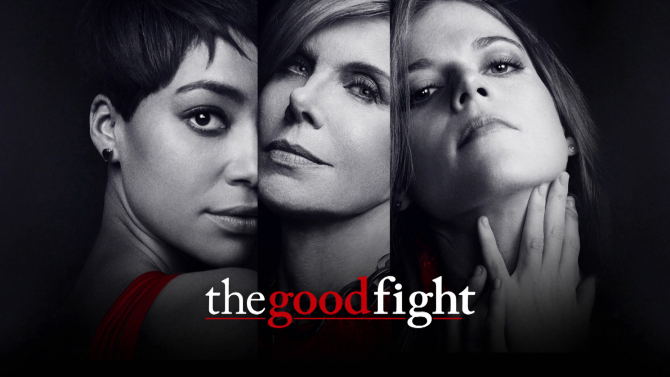
 

The Good Fight is GOOD

To say I was devastated when The Good Wife ended is an understatement. I mean, rare are shows that boast strong characters, incredible dialogue, and such clever twists! And the female power – don’t even get me started! Then there was talk about a spin-off. The Good Fight they called it. No Juliana Margulies this time. Pfft, I thought. No Juliana? Really? How do you expect to spin that one off? Then, I watched it. Now, I AM HOOKED. True, The Good Fight has big shoes to fill (they don’t make them like Juliana), but it has already a strong cast of actors in Christine Baranski, Cush Jumbo (Gotta love her name!) and Rose Leslie from where I last saw her on The Game of Thrones. The creators of this show did well to go after such a string of strong female leads. However, they did not completely alienate the other half of our species, introducing easily likeable and strong characters in Delroy Lindo, Justin Bartha and a comeback from The Good Wife by our very own Canadian, Matthew Perry. A lot of other quirky characters reappear from the mother show, minus of course the Florrick family and my beloved Eli Gold.

I like that this show goes deep into the justice system often acting as a crash course in justice terminology – I mean, they get real in there with concepts like “Fair Use” and “Puffery”. I may not aspire to be a lawyer, but I enjoy that the creators Robert and Michelle King have faith in their audience to count us as smart enough to understand what is happening. The quick pace of this show, coupled with witty dialogue and politically-current material (and man do they get bold with their politics!) really make it a welcome relief in this world of almost-garbage TV. Sincerely, the pilot with [SPOILER ALERT] Baranski’s character sitting in front of a television set disgusted at the swearing in of the current president, is a strong enough statement about the direction of this show.

If you’re in Canada, The Good Fight airs on the W Network on Sundays. For all you The Good Wife fans, you have to see this. It is no Juliana Margulies, but it is GOOD.

©booksnnooks.org All Rights Reserved

Mustang: A Must-See That Will Touch Your Soul

To all my faithful readers, I apologize for the writing hiatus. I blame it on a new job that I have only just gotten around to balancing with blogging. All the same, I am excited to drop my two cents on a film I recently watched! =)

This was another suggestion from my close friend and up-and-coming filmmaker, and what a beauty indeed! Mustang is a Turkish film that opens in a remote village in Turkey. It focuses its lens on the youngest of 5 sisters as the opening credits come to a halt. Young Lale is saddened by the departure of her favourite teacher. Her sisters try to comfort her and together, the five of them embark on an innocent and free-spirited romp on the beach. When they return home later that day, their grandmother is furious and begins hitting them one by one. Their crime? Hanging out with boys “indecently”, credit of a no-good and snitch-of-a-neighbour. The five girls are then cloistered like nuns and in Lale’s words, put through a “wife factory”. So begins this story that will both make your heart soar and devastate you all in the same breath.

Spanning themes of family, loyalty, sisterhood, bravery, abuse, love, freedom and captivity among several others, this film is a piece of artwork on its own. A layperson on film-making, I was still able to appreciate the beautiful angles that were shot, the exquisite song choices and the phenomenal acting by each of the 5 sisters: Sonay, Selma, Ece, Nur and Lale.

Director, Denis Gamze Erguven takes the viewer on a journey that is haunting in its likeness to our lives. As a woman, but also a free spirit, several aspects of this movie resonated with me on so many levels. These sisters are brave and unapologetic of who they are as people. They walk out into the world fiercely and love tenderly and openly. They trust but trust too with reason. They are clever in their attempts to attain their freedom and unwavering in their loyalty towards one another. As someone who shares a close bond with her siblings, this movie brought me to tears and is easily a fantastic movie for sisters who might be looking for a movie to bond over.

I can’t help but think of the applications this film can have to a classroom setting as well. With its strong focus on womanhood and the fight to be oneself in a world that stifles our spirits because of doctrines that are outdated and ignorant, this film poses big real-world discussion questions for courses at the high school level such as English, Family Studies, Social Sciences (particularly Psychology and Sociology), Women’s Studies, Cultural Studies and so on. It is also a fantastic eye-opener into the lives of women in remote places all across the world. An opportunity to see them as one with us, women of the West, an opportunity to feel the thirst of their spirits and the hunger in their bravery for a better life that they alone control.

I will not say more about this film (trust me I could!), mostly because I view this to be that piece of artwork in a gallery that is best viewed and not described. Therefore, whoever you are, wherever you are, this film will change you. Watch it.

©booksnnooks.org All Rights Reserved
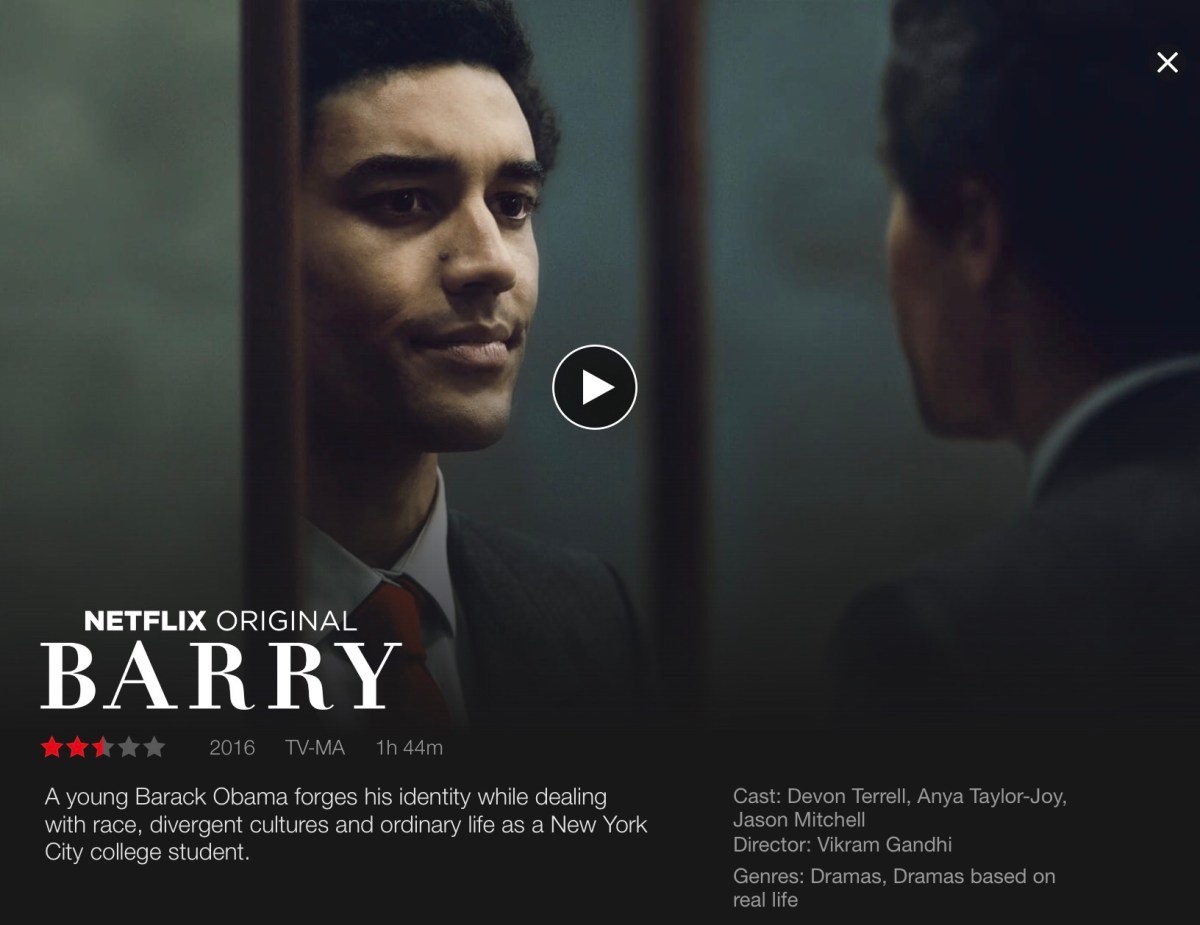
A Note About Barry

As U.S. President, Barack Obama’s presidency comes to a close, Netflix drops this Toronto International Film Festival 2016 premiered eye-opener into the early life of America’s first coloured president. Directed by Vikram Gandhi and starring young Devon Terrell as Barry (Barack Obama), Barry gives the viewer an inside glimpse into who Obama was before he began his path to politics.

With the concept of identity as its main foundation, this film explores the conflicts that a person’s pscyhe endures while trying to find out who he/she is. Springing from a mixed race union, Barry spends his early college years from 1981 – 1982 finding himself through the things he studies in class, his interest in sports, the people he surrounds himself with, and the things he reads. Among many relationships that stand to help shape Barry’s sense of self is his relationship with his father and how a lack of the same impacts the way he sees himself. In trying to find a way to communicate with his father, Barry must come to terms with the portions of his father he has inherited, and the bits of himself that are his mother. He must also decide which battles he chooses to pick in a country infested with racial prejudice. Barry must learn to pick out the pieces of his country that make him who he is and build on the ones he wishes to adopt to add to his current sense of self.

Terrell gives a strong performance as Barry as he navigates romantic relationships, friendships, cliques and familial connections. Barry struggles with asserting his varied upbringing in a country so quick to label based on one’s skin colour. He must prove himself time and again as a smart and educated man of mixed heritage with a familial and cultural background he is proud of. His internal struggle is beautifully captured through silent moments and carefully executed body language. Terrell has even mastered the President’s way of speaking to a T.

And while this film might leave you wanting a neatly-tied up ending, it does exactly what it set out to do in helping young Barry find his place in the world and develop a stronger sense of who he is. For an admirable performance by Devon Terrell and a well-thought-out thematic representation of self-identity, this film gets a 4.5/5.0. If you do end up watching it, you are more than welcome to start a conversation in the comment section.

©booksnnooks.org All Rights Reserved
Where Do We Go Now?: A Stunning Masterpiece

When a really close friend and talented emerging filmmaker suggested we watch Where Do We Go Now?, I was intrigued by the promise of scintillating content. And I was not disappointed. Directed by and starring Nadine Labaki, this film entirely in Arabic (with a French version and with English subtitles) was shot in 2011, and is set in a small village in Lebanon.

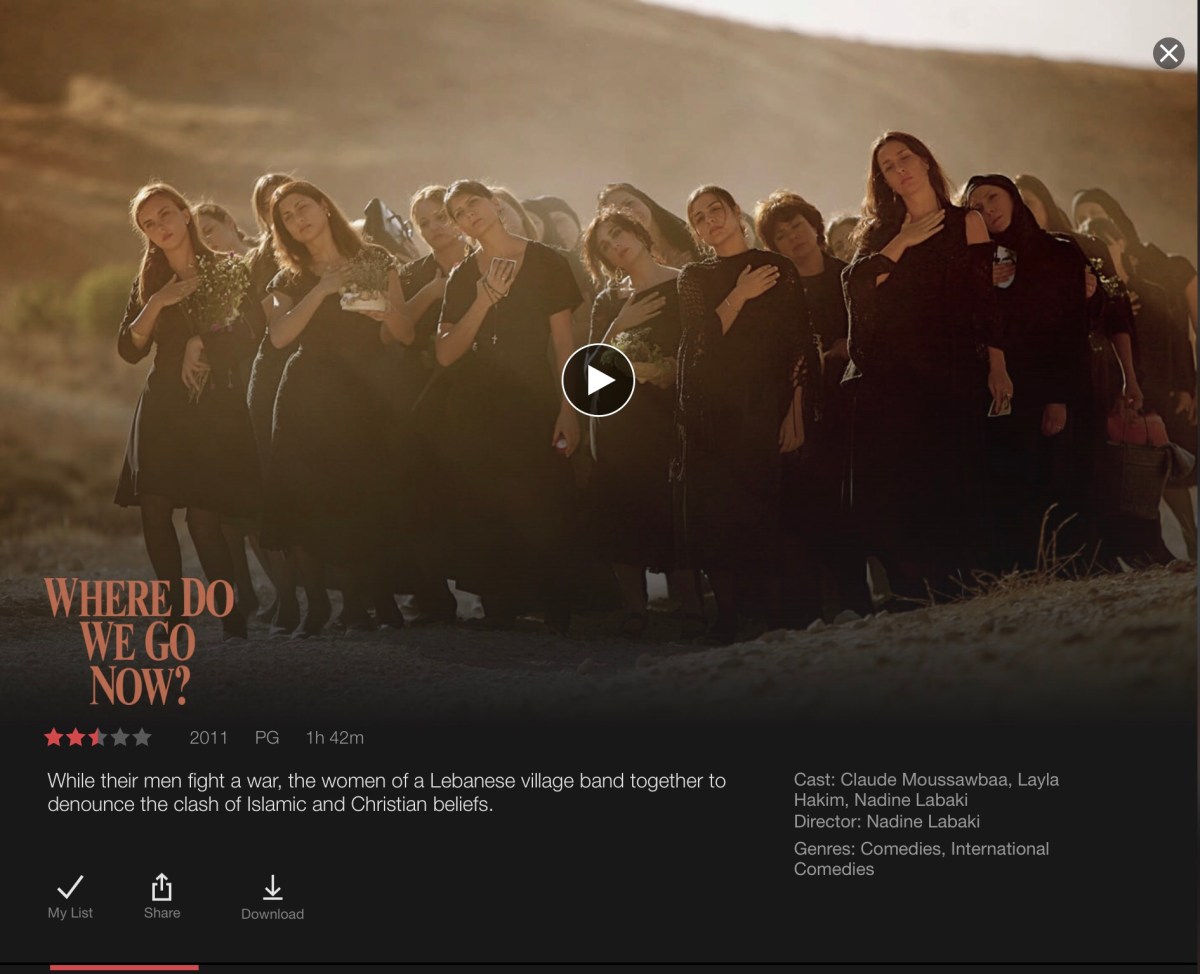
This film begins, as pictured above, with a group of women beating their breasts in mourning. They are mourning the loss of their husbands and sons to clashes between the two religions in their village: Islam and Christianity. The movie features strong themes of female leadership, religiously-motivated conflict, community, hope, forgiveness and love. It shows how when women lead, they lead with their head and not their hearts (contrary to popular belief), favouring the greater good over personal benefit or comfort. Mothers and sisters live their lives on tenterhooks, throwing themselves between testosterone-pumped men who are quick to jump to conclusions about their neighbour and react with violence. The women in this film showcase staggering presence of mind, grace and beauty in all its forms. They go to great lengths to keep the harmony in their village and their men alive. When heartbreak knocks on their door, they answer bravely not crumbling under pressure. They rise up to sacrifice their own personal dreams to save those around them. They conquer hate with bountiful love and understanding, and at no point do they let the bond their gender has necessitated they form come under threat. They band together, Muslim and Christian alike, and show forgiveness and humility. They are the protectors of their men, their homes and their small community. The incredible lioness-like spirit of a woman is so masterfully presented in this 102 minute film

Flipping our deeply-entrenched concept of religion on its head, this film tugs at the heart of spirituality, putting forth the notion that religion is in the heart and not based on whether we hold a cross in our hands when we pray, or whether we put our foreheads to the ground in prayer. It tries to make us see that conflict over religious beliefs is entirely ridiculous because at the end of the day, we all believe in one God.

Community is at the centre of this beautifully-crafted film with this theme echoing in the plots the women devise together. In the way they run to each other’s aid to protect their own and their fellow-women’s sons and husbands. In the way they prepare food together. In the way they work toward religious celebrations together. Even while their men fight each other, these women stick together and it is their sticking together through good and rough that leads to (SPOILER ALERT) salvation.

In its totality, it could be argued that this film challenges the importance of religion over community, ultimately unifying people through love.

While carrying conceptually-heavy material, this film is careful to lighten the mood with candid moments between the strong circle of women, musical pieces that provide gorgeous melodies and profound lyrical movement, and glimpses of hope and happiness.

This film needs to be seen to open up minds closed by conflict and the various divides infringed on us by society and based on the colours of our skin, whom we choose to love or the name of the God we pray to. A stunning masterpiece, this deserves a 5.0/5.0

©booksnnooks.org All Rights Reserved


Love: Really, All you Need

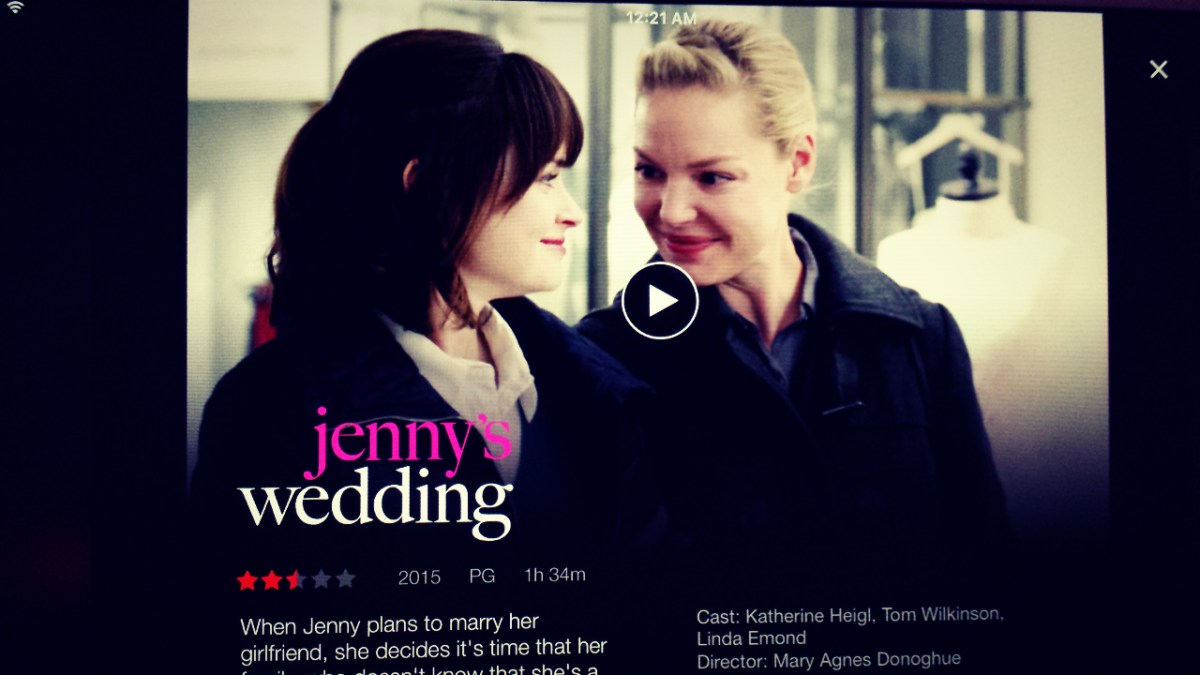
I adore chick flicks, cutesy films that you can rely on to have a happy ending. When I happened upon Jenny’s Wedding, I wanted to watch it because it has two of my favourite actresses, Katherine Heigl and Alexis Bledel. Now, before I launch into a heartfelt review of this movie, I should put forth the caveat that this movie is a heavy one. It weighs down on the emotional quota really really hard, so unless you are comfortable with your emotional side and can handle the flood of emotions you will feel, tread with caution.

Opening with a seemingly-normal family, the film hinges on a truth that lies just below the surface and could destroy the family if it comes out. Jenny (Heigl) is a gay woman who has been hiding her sexuality from her very traditional family all her life. Prodding at the nuclear family structure, this movie delves into the various sides of love. Psychology has dissected love into seven different types: Eros (romantic love), Philia (the love between friends), Storge (familial love), Agape (love for strangers, nature and/or God), Ludus (love for pleasure), Pragma (love based on duty or long-term needs) and Philautia (self-love which can be either healthy or not)  We see many of these types of love in this movie: the love between a mother and her daughter (Storge), the love between a father and his daughter (Storge), the love between siblings (Storge), the love between same-sex couples (Eros), the love of self in a healthy context (Philautia), the love of friends (Philia) and the love of a family as a whole. This movie goes the extra mile to remind us that love comes in so many different shapes and sizes, and real love is big enough to overcome anything, big enough to shine into the darkness that exists within us, big enough to forgive the most hurtful of actions or words, big enough to accept despite the challenges that come with the acceptance and big enough to put another before oneself. I found my heart being pulled in all the directions that this movie could possibly take. Heigl deserves a standing ovation for her performance, as do Tom Wilkinson who plays her father, Eddie, and Linda Emond who is her mother, Rose. While Bledel’s is more of a supporting role as Jenny’s girlfriend, Kitty, she plays it well

This movie takes on a much more serious portrait of a chick flick, using this medium to tap into some very nuanced and important issues that conventional families face these days. With themes of love in all its facets, sexuality, acceptance, forgiveness and family among others, this movie is a must-watch. You, if you don’t already, begin to understand that although people within a family are so different from each other, each is deserving of the comfort and acceptance that comes with belonging to a place of real love. After all, we are all on this earth looking for the same things: love and acceptance.

©booksnnooks.org All Rights Reserved
When Calls the Heart: A Feel-Good Kinda Show

The quality of T.V. shows these days is not particularly consistent. Of course it depends on what you’re into, with some people thriving on The Walking Dead, or others preferring Vision T.V. on Rogers Cable here in Canada for its smart selection of classic British, Canadian and American shows. I’m not a huge subscriber of cable television; maybe if I had more time I would spend it in front of the big box, however, every now and then I come across a show that I find particularly engaging.

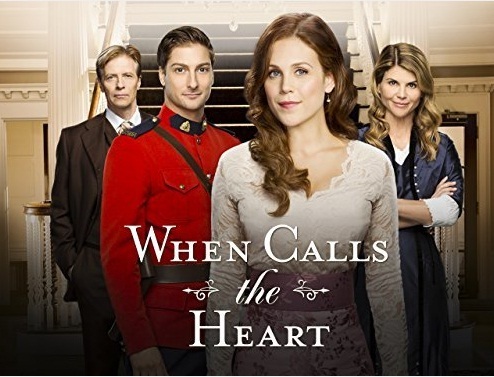
I recently happened upon a Canadian-American period drama (LOVE me my period dramas) called When Calls the Heart, which is based on Janette Oke’s book by the same name. Now, because I am a sucker for history and romance, this was a perfect show to begin binge-watching. Set in the little town of Coal Valley (later called Hope Valley) in Alberta, Canada, this Western Frontier enactment is all about the feel goods. Only sometimes bordering on the slightly cheesy (I think because my generation is just pumped-full of cynicism), this drama delivers such a fantastic portfolio of lessons to build character. Spanning themes of love, forgiveness, compassion, hope, betrayal, death, grief, abandonment, sabotage and justice, this series just leaves you feeling like a better person for having watched it. A lot of us like drama packed with action and courtroom banter and loaded with wit and possibly nonsense comedy, but this show is ‘pure’, for lack of a better word. It upholds the values of kindness, compassion, respect, and love among a list of others, and in so doing provides a lens of purity in our morally disintegrating 21st-century.

Leading lady Elizabeth Thatcher, played by American actress Erin Krakow, is a big city socialite who has come to Coal Valley to begin her dream of being a teacher. Elizabeth is a headstrong woman who needs a bit of roughing around the edges, but who is kind, smart and pioneering in many ways. With a plethora of roles the likes of the dashing Mountie Jack Thornton played by Australian actor Daniel Lissing, the strong widow (and my favourite character) Abigail Stanton played by Full House‘s Lori Loughlin, the bubbly actress Rosemary LeVeaux played by Canadian actress Pascale Hutton, this show boasts a cast of very colourful and endearing characters. You’ll be surprised at how invested you become in these characters when you worry for Abigail’s safety or fret for Jack’s life.

What I love most about this show is that it portrays women in a leading role of strength and honour. The women are forward-thinkers and brave, and showcased in ways that complement their male counterparts. To me this show embodies a lot of what equality of the sexes needs to look like. Men respect women, and women respect men, and I think that it is this lesson that stays with me the most as I wait for Season 4 of this well-produced drama to begin next year. The irony of this statement is not lost on me as this show set a hundred years ago is more progressive than the deluge of TV we see these days where the sexes are just tossed around into total chaos. There is respect in relationships, and couples take their time to get to know each other and value their growing fondness for each other. There is honour, and people do the right thing by each other. There is forgiveness and hope, there is love and unrestrained compassion for strangers. And let’s not even sidestep the incredible chemistry between Erin Krakow’s and Daniel Lissing’s characters! Other progressive themes that struck me are the modern concepts around differentiated teaching and creative strategies for hands-on learning (as a teacher these nuances are quite intriguing), pushing for female education beyond the schoolhouse and women starting their own businesses and doing the handiwork around repairing their homes.

The Canadian tongue-in-cheek humour that we inherited from out British forefathers is quite entertaining, with sass peppered into the female and male characters alike. I am so glad that a show like this has been renewed for a 4th season when feel-good television in the same genre barely makes it past the 2nd.

If you’re looking for a feel-good series about life on the Western Frontier, this is the show for you. The plot is rich, the acting commendable, the setting quite elaborate and the themes totally worth your time. I just might invest in the entire series on DVD for myself! With 10 episodes per season, each episode running about 42 minutes (without ads), the first two seasons of the show are available on Netflix and the CBC TV app, if you’re in Canada. The show usually airs on the Hallmark Channel in the U.S. and on Super Channel here in Canada, with the 4th season premiering sometime in February, 2017. If you decide to watch this show, let me know what you think in the comment section. You can catch a CBC preview here:When Calls the Heart CBC Preview

©booksnnooks.org All Rights Reserved
 

TIFF 2016 – Rage (A Japanese Film)

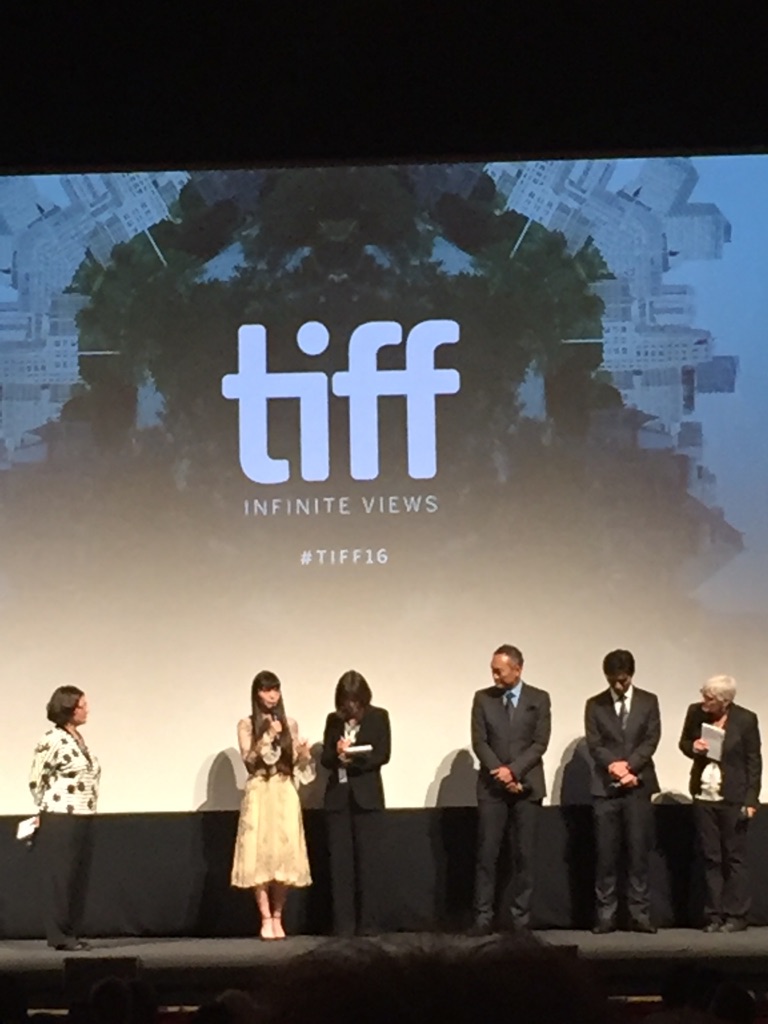
This past weekend I had the opportunity to watch a Japanese movie called Rage by director, Sang-il Lee, at the Toronto International Film Festival. I didn’t know what to expect when I went to watch this movie with, and courtesy of a good friend, but I was moved. The director was present for the premier with two of the lead actors, Ken Watanabe and Aoi Miyazaki, and I must say this trio was a gracious and humurous bunch.

This movie opens with 3 seemingly different story lines taking place in three different places in Japan: Tokyo, Okinawa and Chiba. And no, there will be no spoilers, and this review will abound in brevity and vagueness, but this movie digs deep and uncovers the ugliness of our baser natures. It both terrorizes and horrifies you, all this without being a horror film.

Sang-il Lee has adapted this book by Shuichi Yoshida, and he has gone for the jugular with this one. He makes us bleed at our seams, exposing the evil that resides just below the surface and can buoy to the top at any time. Spanning concepts of trust, revenge, anger, fear, hatred, loneliness, sadness and fetal joy, Rage will leave you questioning what you are capable of when darkness sets into your veins. The characters hold nothing back. They sink their teeth into your emotions and paint you into a corner where you are forced to admit that there is evil lurking inside all of us. A formidable performance by the entire cast, and a dark masterpiece by Sang-il Lee.

I would hail this as a film to see at some point, because I think it allows us to see a more primal section of ourselves without the guilt of viewership.


©booksnnooks.org All Rights Reserved
 

Hitchcock’s Psycho: A Masterpiece

Like I have said in an earlier post, I am a Hitchcock fan. I think he is a genius, but this movie made me think again about the magnitude of his genius. Truly, this man was light years ahead of his time with the way he put together the masterpiece of a psychological thriller, Psycho.

This movie opens with a couple in a hotel. Right off the bat there is a woman on full display in her underclothes. Now, this is not a stretch in movies today with completely scantily-clad women and full-on nudity, but for a film in 1960, I can imagine this might have turned quite a few heads. And this is just the start. Hitchcock pushes boundaries throughout this movie.

Said woman, Marion Crane is a secretary for a real estate company. That afternoon, after a clandestine meeting with her boyfriend, Sam Loomis, and when she returns to the office, a client drops off a large amount of money in cash. Marion seems cool enough about this huge sum of money when her boss tells her to deposit it into the bank right away because he feels nervous about having it around the office. Our lead lady, instead of going to the bank, decides she is going to steal the money to have a future with her indebted boyfriend. So begins a chain of events expertly captured by Hitchcock’s trained eye. The movie is titled Psycho, and this theme of the mind plays in right from the start with Marion role-playing scenarios replete with conversations spoken out by different players. Suspense is threaded into the very fabric of this movie in layers that keep you rooted to your seat (I didn’t move positions even once during the almost 2 hours!). Marion manages a treacherous journey to almost being with her boyfriend. However, a rainy night brings her to the Bates’ Motel. Here she spends a night, and that is where the psychosis kicks in. The owner of the hotel, Mr. Norman Bates, is not all he seems. And Marion might just be in a lot of danger.

Hitchcock marches right into the mind of a deranged killer. Dissociative Identity Disorder (previously known as Multiple Personality Disorder) is the premise of this movie, and while research around this area was being compiled, and various print and media were tackling this subject at the time, Hitchcock (in  my mind) does the best work of portraying and analyzing the condition. Mr. Norman Bates has this condition. How does it play out?

Hitchcock’s angles, as always, are a cinematic technique to be studied, repeated and revered. He has the talent to create fear and anxiety and despair and utter suspense with the way he films his scenes. You get an overview shot of Mr. Norman Bates removing his mother from her room and carrying her downstairs to the cellar. Not too close, but just close enough to get you thinking about what this means and what will happen next. When Lila Crane goes looking for her sister, Marion, in the dark cellar, the shadows and the eye’s view with which she approaches the person she sees leave you immobile with fear. How does a director manage to achieve such a reaction in his viewers? Psychological thrillers these days don’t make you think as much! They don’t respect the intellect of their audience to put things together and create fear where those gaps are being filled. Hitchcock does that! He trusts that his audience is smart. He gives you just enough to create in your own imagination the diabolic scene that is unfolding in front of you, before it does! And then he adds a twist. Just when you thought you knew…

The motif of birds, these ones stuffed, is a recurring one in this movie, and sets the stage for Hitchcock’s later movie, The Birds (1963). Perhaps this was a horror theme he wanted to explore in more detail.

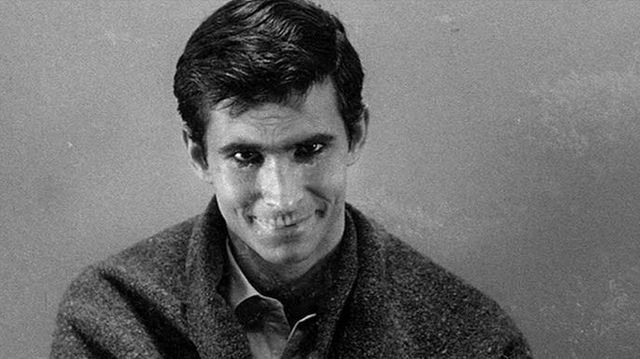
The actors are perfectly suited for their roles. Anthony Perkins as Norman Bates is the lanky and scared son who smiles inappropriately after something morbid is said. Janet Leigh as Marion Crane carries her heart and fear with sass and cleverness. She makes mistakes, but she is aware of them. Vera Miles as Lila Crane is picked for her likeness to Marion as a sister, but with just a bit more grit to make her probe the mystery and uncover the truth.

If you have a 2-hour window and are looking for a REAL psychological thriller, this would be it. Not one of those movies that delights in blood and gore to make you sick to your stomach. Not one of those that constantly has mangled figures hiding in the dark awaiting a “dumb” character’s entrance. No. This one is clever, and gives you as the viewer the satisfaction of putting the events together, before they are fully revealed, with your own cleverness.

So what say you, will you watch Psycho?


©booksnnooks.org All Rights Reserved