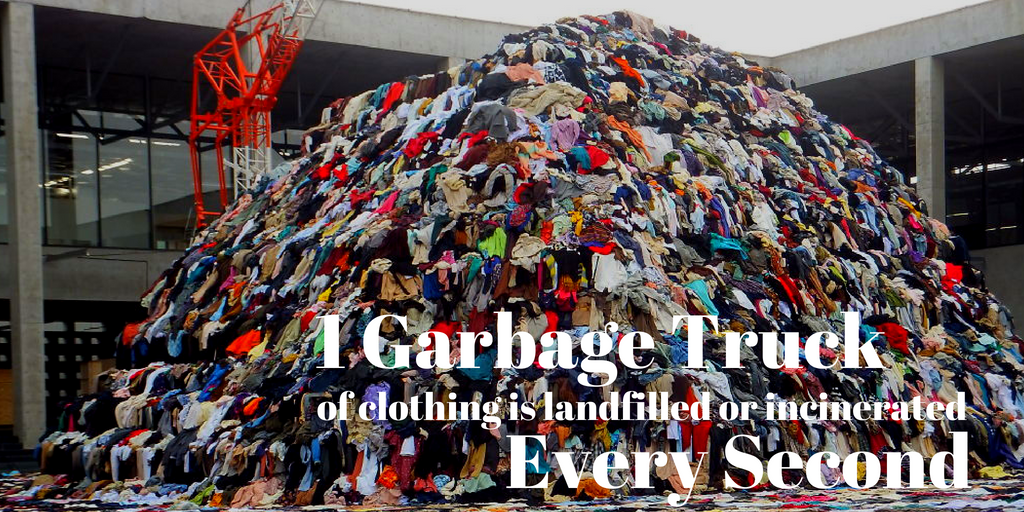
We have fast become a society of excess. If we look at the way people lived their lives in decades past (up until about the 1950s), the excess was not really in style. Our ancestors lived through wars and made do with what they had. They were inventive in their solutions to survive. With the evolution of technology and the improvements in mass production, companies around the world have gone unchecked in what they produce, how they produce it and where it all ends up. They have helped create a society that is wanton in its consideration of the environment and each other.
Today we will take a look at how our life of excess is destroying our environment, by focusing on “fast fashion”.
I gave myself a pat on the back a little while ago for not buying new clothes for nearly 6 months. I am not a fashionista, and in general, the idea of excess bothers me, but I thought I was being disciplined with a view to live on less with this buying hiatus. Wrong. I went on a retail therapy trip shortly after this pat on the back, and bought a bunch of new clothes I did not need. Did they make me happy? Yes, momentarily so, but then I learned about clothes and where they end up, and now all I can desperately think is: Can I return these new clothes, please?
In a world where there is a lot of weight put on appearance, and an ever-increasing pressure to look a certain way so we can belong to cliques and attain certain levels of status, we spend a lot of money on clothes. That is one thing really, but what happens when our direct overconsumption of clothing contributes to an environmental crisis: non-degradable textile waste in landfills? This is where we land today, and elementary teachers, I know I have posted a lot of educational material geared towards the secondary level, but the resources listed here can definitely be used for your students as well.
Before students watch the video below, ask them these questions:
Where do you think your used clothes go after you have no more need for them?
What do you think “Fast Fashion” means?
*Encourage students to share their stories of clothing swaps, donations, recycling etc.
Then, watch this 22 min. and 23 sec. segment of CBC’s Marketplace. Marketplace is a great series by CBC that takes an investigative look into some of the critical aspects of our lives, and this segment really makes you question your “need” to consume fashion.
Consider the following questions in a class discussion to further critical thinking:
- How many new clothes do you buy in a year? (Students can create individual graphs for a math lesson and do a compare and contrast with their peers).
- Where does your family/do you put all your used clothes?
- Why do our clothes end up in landfills?
- Why can these clothes not be recycling like paper or certain kinds of plastic?
- What do you think will happen if we continue to dump all our used clothing in landfills? What can happen to the environment?
- Are companies, like H&M, lying to us when they tell us that all our used clothing will be recycled?
- What do clothing companies who take our used clothing really do with them?
Then, show students the following video:
This video, a follow-up to the one above, is also compiled by CBC’s Marketplace and talks about clothes from Canada that end up in Kenya, and how they are dealt with there. Ask students the following questions after they watch the short 6 min, and 59 sec. video:
- Why do you think Canada sends all our used clothing to countries like Kenya?
- Do the people in Kenya get our used clothing for free? Should they? Why or Why not?
- Do you think this helps the people in Kenya? Why/Why not?
- What are some other ways we can manage all the used clothing we no longer need?
Next, show students this video of clothing waste and how it is managed in Vancouver, Canada:
Use the following discussion questions to get students to think about the video critically:
- Does it surprise you that some women in the United Kingdom use each of their clothing pieces about 7 times only? How many times do you use your clothing pieces on average?
- Can mixed-material clothing items be recycled? Why or why not? What do they contain? Where do they end up?
- What are some of the solutions that this video discusses?
- What is “circular fashion”?
- Would you be willing to buy all your clothing from used clothing stores? Why or why not?
ACTIVITIES TO FURTHER EXPLORE THIS TOPIC:
1. How Can We Help? Informational Documentaries
In my research, I found out that the city of Markham in Ontario (on the border with the city of Toronto) was the first city in North America to ban the disposal of textile waste at the curb. How incredible an idea is this? Well, these guys went a bit further and now they have implemented a textile recycling program where environmental conscientiousness is at the forefront.
Teachers, have your students research their website: Markham, Ontario: Recycling Textiles
Then, encourage them to take a closer look at the city’s document on their Textile Recycling Report Strategy – Markham
Ask students to compile a list of 7 ways in which they can stop the negative impact of fast fashion on the environment.
Ask them to describe each solution using words, pictures, graphs, video clips etc. to create a mini-documentary on these solutions. Have them work in groups and encourage them to be as creative as possible.
When students are finished compiling information for their documentaries and creating them, organize a screening of these documentaries. Have students introduce their documentary to the class before each screening.
As an extension, you might want to organize an assembly for the entire school, with the aim of creating awareness, and feature some of the best documentaries created. Students might even have information booths set up where they talk with other students about their solutions and brainstorm ways in which they can implement some of these strategies together.
Finally, show students the following video about students in Ontario schools for some inspiration (stop the video at 5:11):
2. Additional ideas for how to take this information further:
- Partner with your school’s Eco-Team to create posters and/or information sessions informing students of the impact of fast fashion.
- Organize a Clothing “Shwap” (as seen in the video above)
- Research ways that different governments around the world, and here in Canada are helping to tackle this problem, and have students suggest additional solutions for their governments to consider.
- Have students organize a “Silent Photo Exhibit” where they showcase the impact of fast fashion on the planet, various countries around the world and people in general, using still single-frame photography.
There is so much you can do with the videos here, readers and teachers. Circulate these videos, and find ways to reuse old clothing. My personal goal over the next few weeks is to comb through my wardrobe and sort my clothing into a donation pile (after carefully researching a sustainable recycling program in Ontario where I can donate my clothes: Markham’s program is looking good!) and a repurposing pile (where I find new ways to use the clothing I already have). I will also strive to not buy any new clothing for the next year, or more if I can manage it. Wish me luck.
If you have any ideas for suggestions you would like to contribute to this 31-Day Social Justice Education Project, please send me an e-mail at 31daysocialjusticeedproject@gmail.com. It doesn’t matter where you are in the world, I would love to hear from you and highlight the stories of your lives. Please visit my introductory post about this project for details on the same. Don’t forget to connect with me on Instagram @creativeteachingbybd. As well, if you would like to join in the conversation on Instagram, feel free to use #31daysocialjusticeedproject. See you soon!
©booksnnooks.ca All Rights Reserved
 Books 'n' Nooks