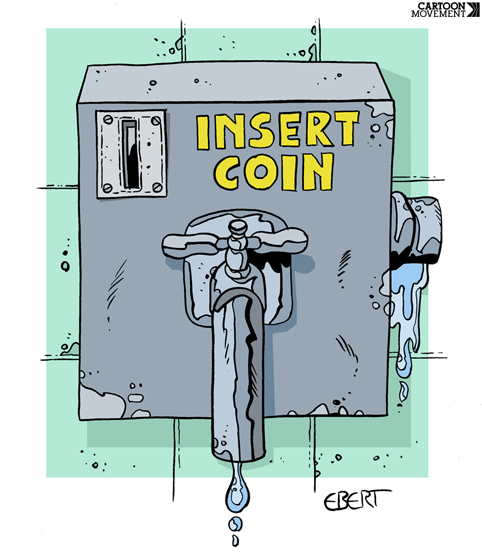
In a closer look at water today (in the second chapter of the Water Series), we tackle the question of privatization. There are people firmly against the privatization of what we hold as a basic human right and necessity for survival, and then there are those in the opposing camp who see the merit of privatization. This is not a black and white issue. In some regions (countries, towns, cities) of the world, privatization works and people benefit from it, but in other areas, privatization is driven by the bottom line, and this is where privatization can be a detriment to the access to water.
First, it would be worthwhile to consider the meaning of “privatization”. Teachers, you can elicit organic responses from students in a diagnostic discussion. List words and phrases that students use to describe this concept on the board/screen. Privatization, in a nutshell, is to make something private. To take control of something and call it your own, whether you are an individual or a large corporation. Privatization is the opposite of making public. What happens when a basic human necessity like water, is no longer publicly-controlled and publicly-accessible? Sometimes, people suffer, and sometimes, the environment suffers.
Let’s begin then. As in yesterday’s post, this is a short (3 min. and 36 sec.) video about the story of water titled, The Story of Water. Again, this viewpoint is one of several that people hold about the privatization of water. This is meant to work as a starting point in this conversation, and to help students make up their own minds. As always, please remind your students of bias and the value of motive in the sharing of a viewpoint.
Some questions to further critical thinking and discussion around this issue can include:
- Why might private corporations want control of water systems?
- How might the privatization of water systems affect citizens?
- What factors might help to determine whether the privatization of water has a positive or negative impact on communities? Might it impact some communities in different ways than others?
- What can the public do to retain control of its water systems?
- Should water remain a publicly-control element? Why or why not?
ACTIVITIES TO FURTHER EXPLORE THIS TOPIC:
1. Write a Research Paper:
Students can write research papers individually, in pairs or in groups that answer the question: Should water remain a publicly-control element? Why or why not? Teachers, it depends on what kind of evaluation you are looking for, and how exactly you want your students to interact with the material (Depending on what subject you teach, you might want students to incorporate charts, graphs and diagrams into this research paper). Personally, I would group students together to have them complete this research paper. Students should use the discussion questions listed above to help them formulate their thoughts and construct an argument around this issue.
Some resources that students can begin with, as they seek to answer this question are provided below. This is not an exhaustive list, but a place to start. Students should check in with you about the resources they choose, so you can help them better determine credibility and analyze for bias.
- PRIVATIZATION OF WATER: EVALUATING ITS PERFORMANCE IN THE DEVELOPING WORLD
- Privatizing Water Facilities Can Help Cash-Strapped Municipalities
- Africa: trapped in water privatization
- The Privatization of Water and the Impoverishment of the Global South
- Water Privatization and Implications in India
2. Complete a Report on the Privatization of Water:
Again, students can do this individually, in pairs or in groups. There are three components to this report:
a. Mapping out Privatization of Water in the World:
For this part, students must research 10 different countries in the world where the privatization of water is a social justice issue. They must use a map of the world to showcase these countries. They can colour-code these countries to indicate which ones benefit from the privatization of water systems, and which ones do not. For example, countries in red could indicate those that suffer as a result of privatization and those in blue can indicate countries that benefit from them.
This activity has a multi-pronged effect:
- It allows students to expand their knowledge of world geography
- It showcases the impact of access/lack of access to water for their brothers and sisters around the world
- It allows students to critically question the way we manage our natural resources and how we consider equity in this process.
b. How Privatization? Why Privatization?
Next, looking at their map, have students write a short paragraph on what their findings say about the privatization of water in these various regions in the world. They must answer two fundamental questions in this process: 1) How does the region conduct and manage its privatization (i.e., what does the process of privatization look like?) and 2) Why does it work or not work?
c. Pros and Cons of Privatization
Lastly, students must compile a list of at least 5 pros and 5 cons regarding the privatization of water. Five is a healthy number here, but use your discretion to determine what is reasonable for you and your students, teachers.
Finally, students can choose what medium they would like to use to present the various components of this report. Encourage creativity and diversity in their reports (if you see several groups doing the same countries, encourage them to explore other ones). Below are some methods that students might want to explore to prepare this report (Please note that there are paid and free aspects of these options; students, unless they choose otherwise, should be advised to use the free versions).
- Make a video using software of their choice. E.g., Powtoon
- Create a Padlet
- Create a Canva
- Try Swipe
- Maybe Evernote
- Or PowerPoint
- Perhaps Google Slides
- Or a Prezi
This concludes Day 3 of the 31-Day Social Justice Education Project! Tomorrow we will take a closer look at the water crisis in our world, in the final chapter of the Water Series.
As always, your feedback is welcomed and much appreciated. Also, don’t forget to send me an e-mail at 31daysocialjusticeedproject@gmail.com with any suggestions you have for social justice issues in your part of the world. Please visit my introductory post about this project for details on the same. Don’t forget to connect with me on Instagram @creativeteachingbybd. If you would like to join in the conversation on Instagram, feel free to use #31daysocialjusticeedproject. Be back tomorrow!
©booksnnooks.ca All Rights Reserved
 Books 'n' Nooks