Recognizing Teachers: Thank You, Todd Parr.

So often a Teacher’s job is berated: “You get summers off” “You get paid too much for the little you do” “You don’t know what you are doing when it comes to raising a child”.  Not a lot of people actually respect the job of a teacher. And while I am not here to dispel the falsehoods that seek to trample my kind here at home, I would like to share why exactly I am a Teacher. And in doing so, a lot of these damning falsities will crumble.

I did not come to the conclusion to be a teacher lightly. No. When I was little, sure, I played Pretend-Teacher. My momma is a teacher and like a lot of  young girls, I wanted to be just like her when I grew up. So I chalked endless mathematical equations, and grammatical sentences, and diagrams on the dark wood door of my bedroom, with an imaginary classroom paying rapt attention to my lessons. And I enjoyed it! I would explain the concepts to my invisible students and then answer their voiceless questions.

Years later, when I was graduating from university, all I wanted to do was travel the world. And I knew I couldn’t do it on my savings, so I decided to build a portfolio that would market me to the international world of employers hiring tutors and teachers of English. So began a couple of years of travelling abroad and teaching students who were 3 years old one summer, and then 18 years old the next winter. And it felt good! At the time, I thought it was just the freedom and the opportunity for self-discovery and exploration that gave me such joy. However, when I returned home, I realized that continuing teacher-like jobs still afforded me the same happiness. So, at the urgency of friends and family, I began my journey to becoming a teacher. Today, I work in the school system and no matter how hard the day stretches before me, I am content. I have the opportunity to help in a way that I have wanted to since I was a child. In what other job could I be surrounded by a classroom full of young minds hungry to learn what it is I have planned for them that day? In what other job could I smile when I see one of my students complete a task (s)he has been struggling with since the beginning of the school year? Or when I am coaching cross-country and one of my students decides she is going to push herself to be a stronger runner after heeding my encouragement? Or when I am able to deliver a book of interest into the excited hands of a student who does not really love reading? What other job is out there where I can help make such a positive difference in the life of a child?

Some of the most valued people in my life are teachers. Some of them have been instrumental in bringing me to where I am today. Such is the destiny of a teacher, and I wanted to continue that trend. For me, being a teacher is a vocation, and within that vocation, my students’ education and well-being becomes the priority.

I know the job of a teacher is difficult. With the limited, and soon-depleting, resources and supports in many school systems, that job is made harder, whether the outsider is privy to it or not. As teachers, we don’t spend our lunches and recesses coaching children who are struggling in Math or Science because we get paid more. We do this because we want that child to succeed, because we want him to know that we believe in him, and hopefully one day, he too will believe in himself. As teachers we do not offer 2-3 extra hours a few times a week to coach soccer or hockey or chess club just because it is a party and we get paid more. No, we do it because we want to inculcate a valuable skill-set within our students. A skill-set that will prepare them well for a healthy and well-rounded future. As teachers we don’t spend evenings and weekends and summers devoted to our own personal enjoyments, but devoted to planning different lessons for all the different learners within our classroom. We make sure that because Tommy is a visual learner the lesson should have pictures, and because Jane learns better with sound we should play an audio clip to illustrate the concept, or because Matthew is a tactile learner, there should be a hands-on activity to fortify understanding at the end of the lesson. And then, there are our students who need us a little more; maybe they don’t get it the first or the second or the third time, and therefore need extra time that the regular class schedule does not allow for. Or maybe we have students with autism or dyslexia or other intellectual abilities that do not allow us to teach everyone with a one-size-fits all lesson. Or maybe there are students who have severe emotional needs that no one else is meeting, and cannot learn at the same pace as their peers. We step in and play a plethora of different roles: Teacher, Instructor Therapist, Counselor, Mentor, Nurse, Cheerleader, Confidante, Disciplinarian, Coach. We do not sit behind our desks and just do paperwork. No, there is much more to the job.

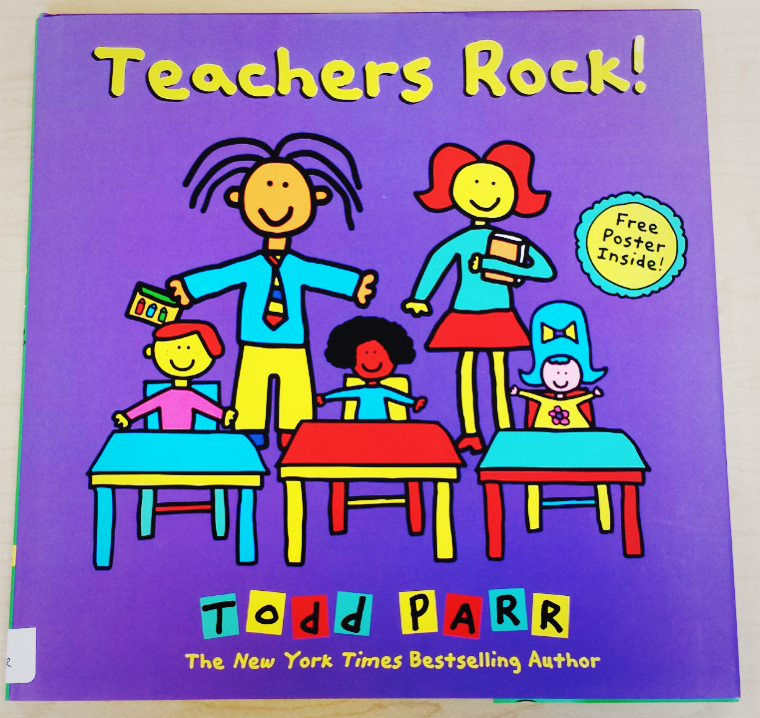
Therefore, when I came across Todd Parr’s Teachers Rock!, I felt a smile edge onto my face. At first I was surprised, because really, ask a handful of teachers, they are not used to receiving much, if any, praise or recognition. However, here is an author who gets it. Parr has an accompanying beautiful illustration for everything a teacher does, and his sensitivity to the minutiae of a teacher’s job is truly heart-warming. So, thank you, Todd Parr, truly, for understanding and standing by us. And all you teachers out there, this is a copy you’ll want to own. If not for your students, then at least for yourself. You owe it to yourself to be reminded of what a good job you do for your students.

©booksnnooks.org All Rights Reserved
 

Harvey: A Simple, Yet Artistic, Account of Loss and Grief

Rating: 5/5

Let me begin with a warning that today’s blog discusses a concept that makes many of us grimace with pain. Death. Five letters that can quite literally shatter our lives. When I came across this book by Hervé Bouchard and Janice Nadeau, I was both deeply moved and in awe.

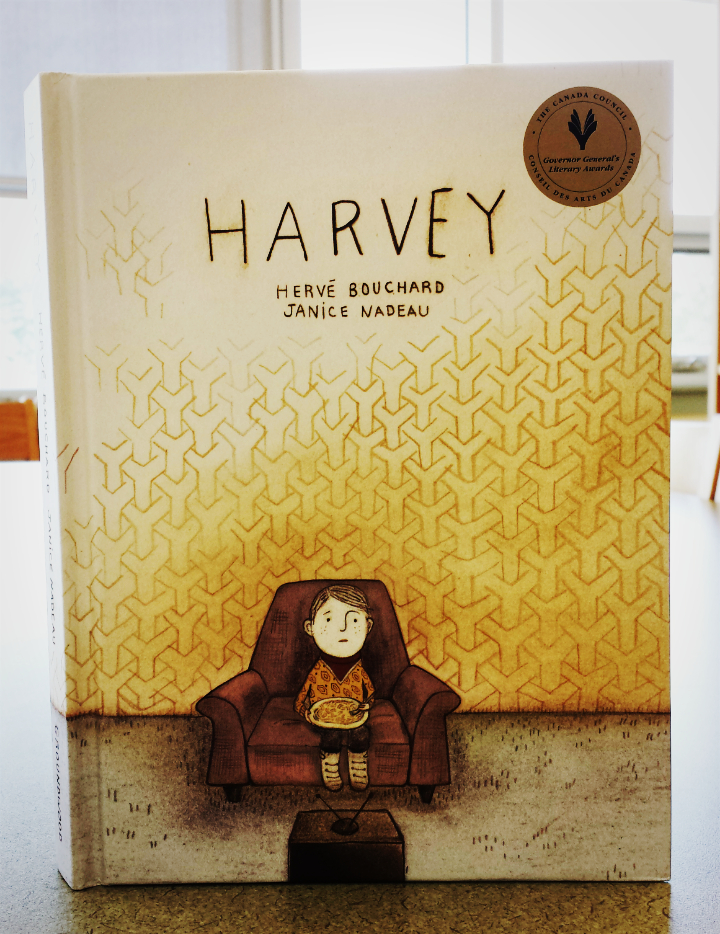
Harvey, written by Hervé Bouchard and illustrated by Janice Nadeau is a project that truly synchronizes illustration with text. And with that segue, I will begin with the technical elements that make this book a gem to own. When I think about categorizing this book, I am unsure whether it falls within the realm of picture book, it is a bit too long for that, graphic novel, while it does have graphic illustrations and real-time dialogue(minus the speech bubbles) it is missing the characteristic panel-structure of graphic novels, or junior novel, the subject matter and the textual length and level seem to offer signs of this. I then came to the conclusion that it really is all 3: picture book with a hint of graphic novel and junior novel.

Now, the subject matter focuses on the death of our main character, Harvey’s, father. Harvey and his brother, Cantin, live in Quebec, and on their way home from school one Spring day, find an ambulance and a crowd of people outside their home. A stretcher holding a blanketed figure is brought out of their house with their mother wailing behind. Then, a key set of events is set off in slow motion as our writer and illustrator quite dexterously capture the grief inherent in loss. A child often processes the loss around death differently than an adult. And while the stages of grief are similar for more or less all of us, children often are left confused and filling in the  gaps that a loved one’s demise has created. There is the knowledge of loss, but pieces of  life seem to move out of kilter, with a child having to struggle to return to some semblance of normalcy. Harvey processes his loss in a very practical matter. He lays out the facts and then follows through on what must be done to deal with his father’s death. His younger brother, Cantin, however, takes a different route when dealing with his loss. His reaction is more emotive. Harvey is the older one of the two and perhaps this difference in reaction is in part due to age and maturity. I would argue though that loss affects us all differently depending on our different personalities. The matter-of-fact text that Bouchard uses to explain the progression of events gnaws at your mind and heart. Nadeau is exceptionally  clever with her use of colours and lines and spaces. She employs darker, smudged-out, and consistently  faded and ragged colours to convey the heaviness of loss. A “grayness”, both of feeling and colour, hover over throughout the book. I don’t normally tout the illustrator of the picture books I review, but that is usually because the text stands out more to me. In this book, Nadeau’s illustrations take the cake. She is superbly talented in conveying the gravity of emotion and state of mind that someone dealing with loss encounters. And it is this talent of hers that I believe renders this book a masterpiece.

Winner of the Governor General’s Literary Award, this book is a gentle reminder of death looming in lives. It offers a raw interpretation of loss suffered by a child and in doing so, makes us as adults more keenly aware of how we can better support our young ones through such a difficult process.


© booksnnooks.org All Rights Reserved


Making an Eternal Case for the Printed Word

The printed word, such as a hard copy book, is not a gem that is appreciated by all. My fellow book-lovers, you will understand when I talk about the absolute euphoria I feel when I open a new shipment from Chapters and Indigo to find beautiful hard copies of some of my favourite titles.

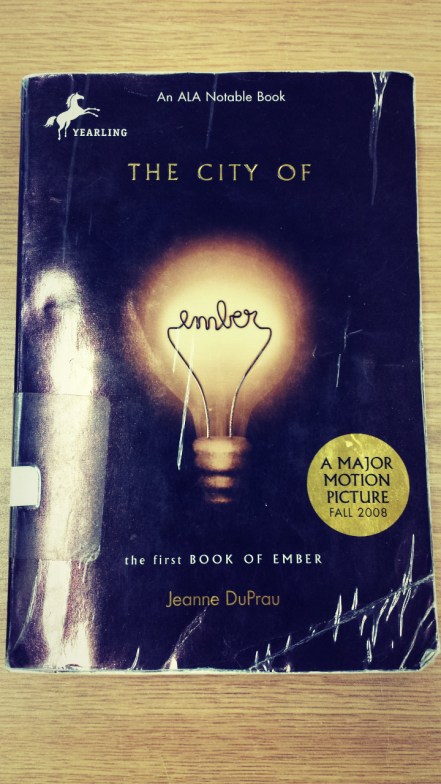
Now, commercial giants, and those looking to create new and inventive technology have, over the last decade or so, tried to reinvent the way we read. And, while I have no real dual to enact with the Kobo or the Kindle or the other what-have-yous out there, I feel it is completely necessary that I champion the printed word as the best invention ever. Yes, I will concede that e-books are able to make accessible reading in ways we could not have imagined before, such as what do I do when the lights go out and it’s dark and I still want to read? Cue headlines: Order is restored with My New Kobo Amidst a Frenzy of No Electricity! Or, Kindle Solves Space Issues: Every Title I Ever Wanted in One Compact Device! Now, while these reasons are all great to catapult stories into the 21st century, and let’s not forget, make millions of dollars, there is something to be said about a plain and simple paperback or hardcover that you house on a shelf. Never mind the intoxicating smell of a brand new book, or, for those of us more sentimental readers, the concreteness of the page to flip back and forth, the option to pen down your thoughts and ideas in the margins for someone else to find a few years from whence you last held the book. Never mind all of these. Imagine now if you will, a society where all is destroyed. Where human beings remain, but all the inventions and luxuries that make our lives easier are demolished because of war or natural disasters. Now, imagine that the only thing left behind is a large edifice stocked with some of the world’s best books. Such is a world created by Jeanne DuPrau in her City of Ember Series. Jeanne skillfully brings front and centre the problem of a world with no electricity or technological invention with which to learn or communicate. Instead, our merry band of characters finds a way to pull themselves out of a slump of human intellectual degradation by, in various ways, using the printed word. Be it letters passed between people, or journals left behind for the new blood to read, or just books about space and electricity, the printed word is an invention that helps to bring back a generation groping in the dark for evolution.

In his book, It’s a Book, Lane Smith illustrates with candour and cheekiness, the merits of a book. He juxtaposes the characteristics of a book with the mobile devices of our current lives, and through it, showcases the simple, yet everlasting quality of the printed word. Maybe Smith happened upon this idea in an attempt to leave behind a memoir of the printed word should it ever fall into an abyss of non-existence, but I don’t think such will ever be the case. Not merely because as human beings we are a sentimental lot, but because there is sheer practicality inherent in prolonging the lineage of hard copy books everywhere. Hard copy books are a way for generations to communicate with each other. They are a way to reach beyond the dead and continue with the evolution of our species in the absence of the inventors of scientific, literary and other advancements. They are a way to learn new things to further our own minds and a means of finding connections to each other regardless of barriers in race, intelligence, creed, or gender. They are doors to new worlds that we may never visit. They are sanity-keepers for those of us who enjoy unwinding with a good book. They are worlds to escape to when our lives get messy and too hard to live.

Working in the school system, I have seen and heard of initiatives to move toward a more Learning Commons way of education. And while marrying technology with books is great, some administrators have the wrong idea when they champion only laptops and iPads over books on shelves. Not all students have access to laptops and iPads beyond the school grounds, but every child can, and should, have access to a book from the school or public library.

The printed word will never go out of style, and so pushing toward a paperless world where we undervalue the contribution of the hard copy book is not the wisest course of action. Technology will advance, and maybe someday be completely obliterated because of a man-made or natural calamity. Maybe a universal blackout will wipe out all means for us to communicate with each other via our mobile devices. Either way, the printed word, hard copy books will remain permanent means of education and communication and wonder.


© booksnnooks.org All Rights Reserved


The Munsch on a Lesson in Selflessness

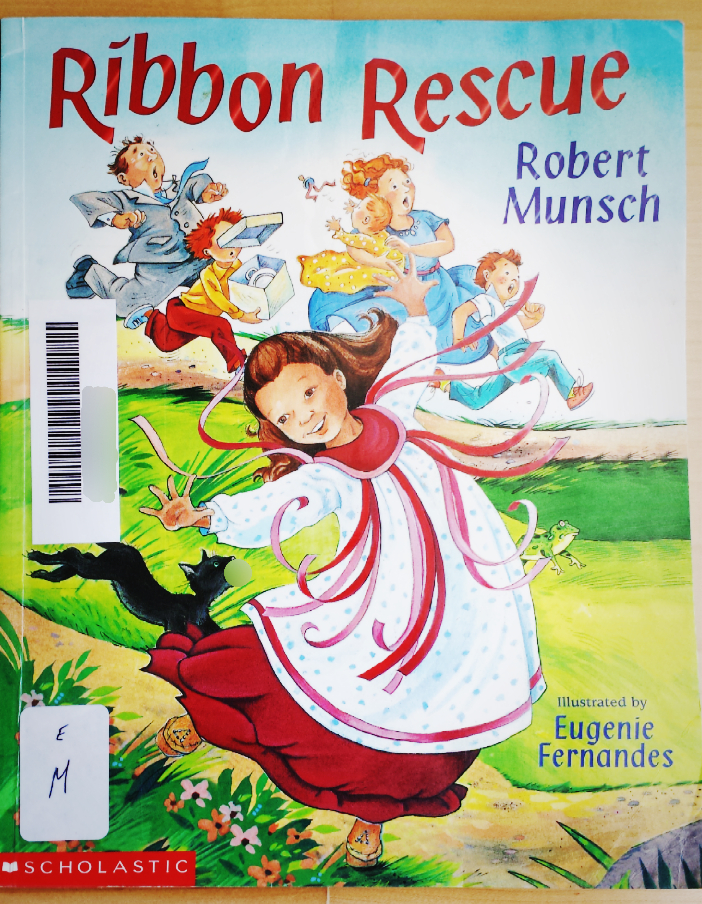
No really, who doesn’t love Robert Munsch? Robert Munsch is one of those timeless Canadian authors who makes me proud to be Canadian. His books are always based on real-life people, and every now and then, amidst the hilarity and the true-to-form made-up sounds, there is a moral. Cue entry of this book, easily one of my favourites from the Munsch.

Ribbon Rescue by Robert Munsch is one of those books that leads readers on a journey to discover their inner selflessness. Based on a character who is of Indigenous origin, this book really gives voice to the culture of our Indigenous brothers and sisters in a light-hearted and compassionate way. It is true, a lot of books written by, or based on, Indigenous characters tend to be heavier, with sadder, and often horrific, undertones. While that entire breadth of literature is essential for our Canadian Literary Canon, to ingrain in our minds the requisite components of our Canadian history, Robert Munsch goes off on a lighter tangent to showcase the grace and kindness of this beautiful culture.

Our main character, Jillian, is a young girl who dons a traditional Ribbon Dress and throughout the story, she selflessly offers ribbons to different people who cross her path and seem to need them. Eventually, she is left with nothing and this puts her at a disadvantage, but is her selflessness enough to overcome that disadvantage?

Munsch weaves a compassionate story-line that allows parents and teachers alike to pose questions to young learners about what Jillian is doing. Teachers, your young students might describe Jillian as “kind”, and “nice”, and “sweet”, but herein lies a fantastic opportunity to teach them how to exercise the kinder and selfless side of their everyday selves. This picture book is ideal for a bedtime story or read-aloud with children aged 4-8, and offers plenty of invaluable teachable moments. So pick up a copy of Ribbon Rescue today, and like me, you’ll discover how much young readers (and YOU) will love it!


© booksnnooks.org All Rights Reserved

Picture Book Spotlight: Educating Our Children about Homelessness

Homelessness is a growing concern in our society in North America. As Canadians we sign off on millions of dollars in relief aid to the needy in other countries, and as we should – because we are a generous lot and generosity helps make everyone a little richer, but what of the homeless in our own country? The poverty-stricken men and women, or worse still, children? No, to this problem we turn a blind eye, a deaf ear, we walk quicker. And I think that stems from a culture that is lacking in education around this concept of homelessness. What is homelessness? What does it look like? Whom does it affect? These are questions we need to ask ourselves before we as adults make quick judgments about homeless people we see, and then pass these judgments off to our children. Children feed off the exemplars in their lives. They practice what they see, not what is preached.

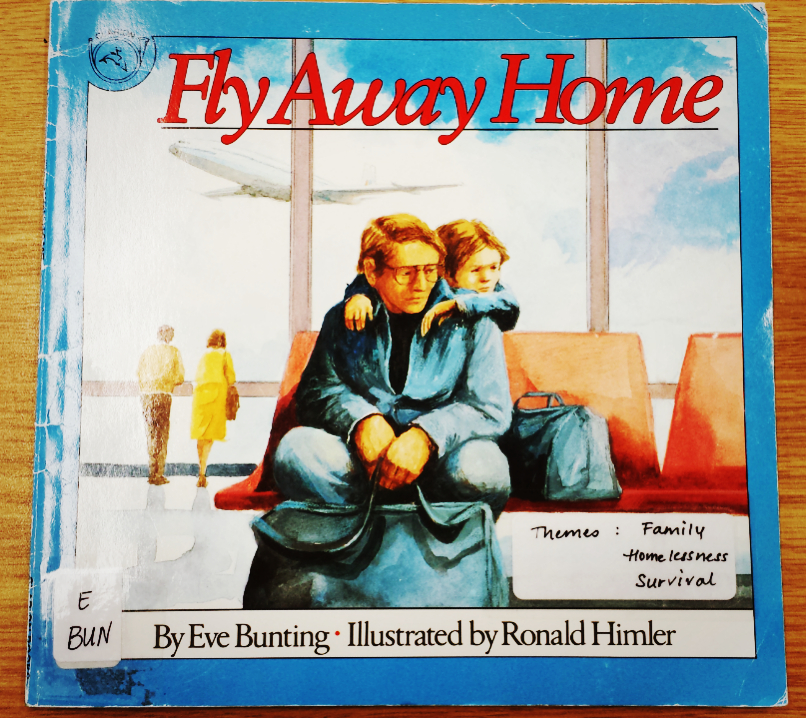
So, when I came across Fly Away Home by Eve Bunting, two things happened. For one, it broke my heart, and then, it provided me with an Aha! moment. I could use this book to teach my young students a little about what homelessness looks like! And so, I did a Read-Aloud using this book with students in Grades 1-3.

Told from the perspective of a 5 year-old boy who is homeless and lives in an airport with his father, this story is delivered with compassion and sensitivity. The facts are laid out for us to see. The day-to-day lives of the father and son, as they struggle to outwit airport security by blending into the travelling consortiums that hustle and bustle through the airport, are shown to us. The little boy learns a lot of wisdom at a young age, and this book nudges in a couple of really good metaphors to help understand the mindset of a homeless child better. Teachers, you can pause at various moments in the story and ask your students why the father and son are doing the things they are, or what certain things mean. Their answers will surprise you, and in turn you will be able to surprise them with yours. Among other themes that Bunting weaves into this delicate tale, are those of family and survival. The things you do to stay together and stay alive and well. There are sad moments to this story too, but there are moments of hope and positivity, where students can learn that people can still shine bright their candles of hope in the bleakest of situations. When you have finished reading this with your students, you will find they adorn a new-found appreciation for the homeless and their difficult lives. And in doing so, you will help to make them more sensitive to the aches of society around them.


©booksnnooks.org All Rights Reserved


Jeanne DuPrau, Junior Novel Genius: Citizenship Education

So, I don’t use the term “Genius” very often. Sure, Einstein was a genius and your dog might be a genius because he’s figured out which one of your twin nieces is Judy and which one is Jenny before you have, but in a world saturated with people trying to achieve the ultimate, my concept of genius is reserved for a scant few.

Jeanne DuPrau however, is a genius. With her The City of Ember Series, she not only captures the imaginations of young and adult readers alike, she uses her compassionate voice to galvanize our kinder selves. Here’s how:


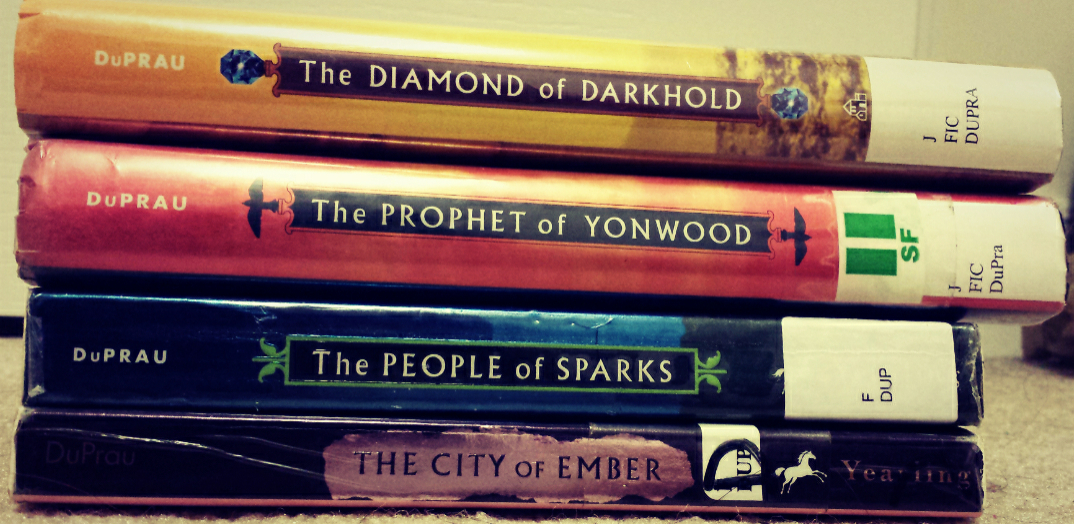
Book#1: The City of Ember

wp-1464191728722.jpeg

I happened upon The City of Ember, DuPrau’s first book, when one of my colleagues decided to do it as a novel study with his students. He meant to simply delve into the genre of Science Fiction with his class. A pilot project of a different genre, if you will. The result was not just his entire class yanking the books off every shelf to continue the series, but I too checked out this entire series from the local library.

This first book starts off with two very strong characters who find themselves partners in a journey to save their people, the Emberites, from total destruction. Young Lina is a fireball of energy and she has her conscience ground on tight. Young Doon has a few lessons to learn along the way, but he surprises everyone with his bravery at key points. The setting of the City of Ember unfolds a fantastic tale of an underground city built to survive destruction. The Emberites are not aware that they exist below the surface, they do not know what the sky or the sun are. Their daily existence is dictated by the timing of the floodlights that line their buildings and streets, lights that have been going on and off on schedule for nearly 200 years…until they start flickering. Can the people of Ember escape before the electricity that powers their daily lives gives out? Or will they be lost forever in an abyss of fatal darkness? This first installment explores themes of courage and perseverance. It explores themes of friendship and loyalty. It explores familial bonds and doing what is right. It explores our human need for survival even if severe risk-taking is the only option. This first book will leave you clamouring for the next three until the final, satisfying finish.

Book#2: The People of Sparks

wp-1465321629118.jpeg

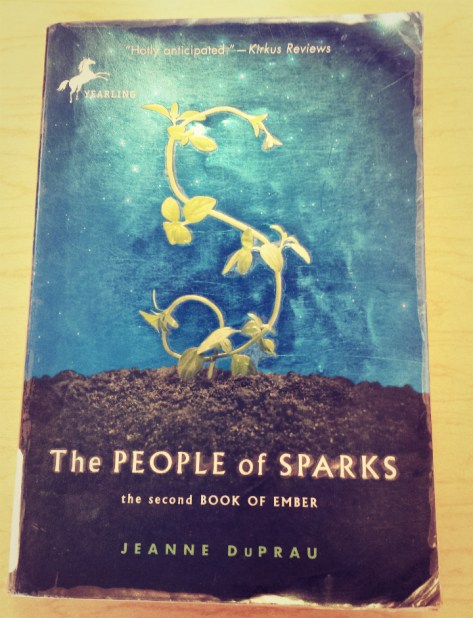
The second book in the series, The People of Sparks unveils what happens when different communities are forced to live side-by-side. It teaches readers of all ages the valuable lesson of how anger and violence can decimate relationships and entire societies. It promotes non-violence and peace, no matter how much hardship must be endured to find that peace. It brings forth the human desire for being good and giving good to our fellow human beings. However, it also shows our primal nature for self-preservation in the face of impending danger. Above all, it teaches the reader that there is a fine line between that choice, and making the wrong one can have catastrophic outcomes for all of mankind. Lina and Doon are back, but this time in a different place than their native Ember. This new world is strange and hard, but Lina and Doon, along with a whole lot of other characters are not crushed.

It is in this book, that the reader is made aware of the Great Disaster that nearly demolished all of mankind. Themes of human greed and kindness, wisdom and violence are explored with very compassionate conclusions. In many ways, DuPrau weaves morality and better ways of being into her books. And this is where her genius shines brightest, in her sensitivity to the evil that exists in our world, and her ability to find a way to take a strong stance against it. All this, with a non-violence the likes of Mahatma Gandhi. In this second book, readers are, or maybe just I was, moved to tears at the goodness of humankind. Cue #faithinhumanityrestored.

Book#3: The Prophet of Yonwood

wp-1465321723384.jpeg

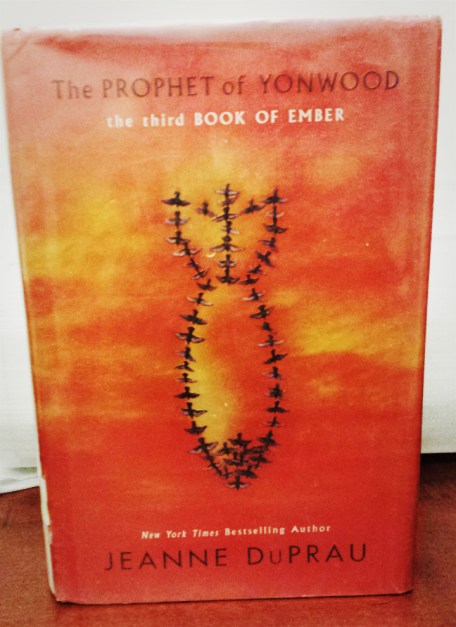
The Prophet of Yonwood is perhaps my least favourite of the series (if it is possible to have a least favourite in this series). It attempts to explain the existence of the riveting events in the first book, and guide along any predictions for the last and final book that the reader might have.

In this one a very flimsy story is built around a lady named Althea Tower and her “prophecies” as reasons for the way things are in a small town called Yonwood. We meet new characters in this book, because this one in chronological order, precedes The City of Ember and exists hundred of years before those events. Much of the story seems like a filler to explain minute details that I think the reader could have put together for him/herself with the help of a brief preface from DuPrau, in possibly the last book.

We meet the characters of Nickie and Grover, characters very similar to Lina and Doon in The City of Ember and The People of Sparks. These characters seem to slosh about in this book, biding their time until the very end when things are revealed to the reader. They plunge along sans meaning many at times, and they seem to know this as they take on bonds with animals to fill in their time in this book. Stories branch out of the woodwork and take on weak tangents before finding a quick and slightly bewildering path to an end.

However, this book is not all a waste of its 289 pages. It brings about the questions surrounding faith and how one comes to develop a sense of right and wrong. It is very profound in its exploration of this multi-faceted conundrum, and DuPrau manages to do this in a manner that does not patronize. The main character, Nickie, is plagued with her notions of what faith is and what is right and wrong in relation to what she believes and what other people tell her. Nickie trundles through the book and arrives a much-changed character at the end of the book where we see she has grown herself a strong foundation of morality and her own faith.

The question of the existence of God is put on the table, and even though much of this entire series has a strong Science-Fiction element to it, it is equally acknowledging and respectful of religion and faith. And this is one of the many things that makes DuPrau a must-read author. She offers always, both sides to the coin, not a biased version of just one perspective. In doing so, she positions her books in a very powerful position to help growing minds too, to see both sides to each coin.

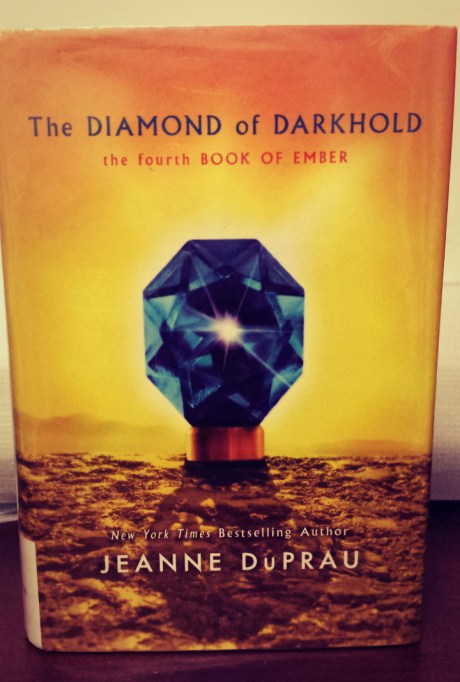
Book#4: The Diamond of Darkhold

wp-1465321671687.jpeg

The Diamond of Darkhold is the final book in the series, and what a joy it is indeed! It brings full circle with absolute brilliance, the journey of not just Lina and Doon, but the entirety of humankind. The very final secrets are revealed, and humankind seems to find herself back to the very threshold of the powerful beginning when things were simpler and war and disease did not devastate.

The courage of Lina and Doon make a comeback in this book, but DuPrau has become braver and she has reckoned that so has her audience, and as a result she plunges her readers into terrifying depths with this last installment.

Selflessness and the desire to contribute in a meaningful way are two ideas that are thoroughly championed throughout this book. So is the very important concept of forgiveness. Lina and Doon risk their lives to help their people lead a better life, and in doing so provide hope for the future. In this book too, DuPrau gets more creative and technical in her understanding of various scientific elements, specifically Electricity. She champions solar energy and clean living, other lessons that I believe are crucial to growing minds everywhere.

All in all, DuPrau offers hope amidst a destroyed civilization, always with the caveat to be good to each other and not live greedily. As she paints the pictures of evil and destruction and hardship, she places in all her readers the knowledge that our existence (with our inventions and lifestyles) are but mere grains of sand that can be wiped out in the event of major catastrophes. Extremely fragile. DuPrau attempts to instill a humility in a society too plagued with the self and airs of entitlement.

Conclusion

Throughout the series, you will laugh with, and cheer on the main characters, Lina and Doon. You will grow to revere Doon’s father and Mrs. Murdock and develop a sibling-affection for little Poppy. You will even feel a fondness of Maddy, the at-first gruff, but finally gentle-hearted roamer. Jeanne DuPrau’s books seek to explore the human psyche and the forces of evil and good that bubble just below our surfaces. She experiments with different scenarios to determine which force will rise to the forefront at any given moment. And she does this without the  jargon associated with many psychologists, both past and present. DuPrau allows us glimpses of our world’s outcomes depending on the decisions we make.

Until now, the only series that has really thrilled me has been Harry Potter by J.K. Rowling. However, in many ways, this gem of a series by Jeanne DuPrau has the potential to go even further in being, not just stellar literature for young children (and adults) everywhere, but purposeful reading that can seek to bring positive change to our world. This entire series is a MUST-READ for students at the Junior Level (Grades 4-6), so teachers, take note! It helps with their Citizenship Development, making them into more responsible leaders for our future. I vow to teach this to my junior students someday, but until then, these four books will be making their way to the shelves of my personal library.

© booksnnooks.org All Rights Reserved
 

A Catastrophic Epidemic. No, Seriously.

wp-1464884396557.jpeg

Okay, so, I LOVE the English language. I love the way it sounds and the way it writes and reads. And yes, it may be the most “corrupted” language in the world where it has borrowed and stolen from every other language out there, but I like to look at it as being versatile. So, please take a moment then to appreciate my horror and absolute disgust at the decimation of this very versatile and universally-beneficial language. Let me explain.

There’s too many people here. 

What is wrong with this sentence?

The English language has grammar, a set of rules that dictate how a language is written and spoken. Now, over a rigmarole of years (and this is where that notion of “corruption” comes into play), these grammar rules have been poked and prodded at to tweak and change for different conveniences. Marketing Suits might come up with a catchy phrase that drops the plural in favour of the singular, or maybe an apostrophe is omitted because really you couldn’t be bothered to type out the entire thing in a text message (Your versus You’re…ring a bell anyone?). Now, while these are convenient ways to communicate, the crux of the language is scattered away to the sidelines. The bare bones that make up the meaning are shunned to make way for “the cool” or “the new”. The English language is cool as it is, and it is constantly assimilating with our changing world to include new words. Why then must we butcher it so?

Now, back to my earlier example:

Is is a conjugation of the verb To be that is used with a singular pronoun or noun.

E.g. She is, He is, The cat is, Much of the sugar is

Are is a conjugation of the verb To be that is used with mostly plural pronouns or nouns.

E.g., They are, We are, The dogs are, Many people are

Notice how the first example incorrectly matches a plural pronoun (many people) with a singular conjugation (is) of the verb To be?

The correct sentence then is:

There are too many people here.

This is truly (and no, I am not being dramatic) a Catastrophic Epidemic that needs to STOP.  Why reduce the English language to a hodge-podge of sentences lacking correctly-placed apostrophes and appropriate verb conjugations?

Why, if this continues, the English language will be nothing but a bunch of letters strung together like this:

Icantunderstandwhythisishappeningandevenifyoucanreadthisitdoesntmeanthatitmakesalotofsense.

Or like this:

LOL  TBT  TMI

What is that anyway? Code for I am so smart, I put an entire sentence together with capital letters? What if I don’t understand you? What if I don’t know that TBT means Throw Back Thursday? I mean really, someone just made it up, and then hash-tagged it (see, hash-tagged, a new verb. The English language should EVOLVE, not DEVOLVE) and then it caught on like wildfire, and if you’re standing around and we’re having a conversation and you threw in a TBT, I would just stare at you and then likely shake my head in dismay. Now, I take no issue with new words added. Like I said, English must evolve. However, could I be spared the bombardment of OMGs and 2G2BTs and 2NTEs and AAFs (If you’re wondering what these mean and are starting to come up with the notion that I am a hypocrite for knowing them, simple, I Googled them)?

Now, while this might be met with Mehs and shoulders bouncing in slow motion, and be lauded as, “Oh stop, you insufferable Grammar Police person.”, let me assure you that this is not just a personal affront to me (and proverbial Grammar Police everywhere), it is a gigantic injury to the entirety of the English language. And let’s not forget the added insult where we, the Grammar Police, roll our eyes and turn our noses up at you for misusing the language.

Honestly, how could we possibly take you seriously?


© booksnnooks.org All Rights Reserved
Picture Book Spotlight: A Slight Change in Perspective

Let’s face it then, in today’s world with messages about the way we should act and dress and talk and smile, children don’t really have a fighting chance to decide who they are and love themselves for it. There is so much pressure on our little ones today, that it is a wonder not all of them break under it. Little girls as old as 5 are wearing makeup…trust me, there is a lot wrong with that. And while that is in itself a discussion for another blog, I would like to talk about a Picture Book (Because let’s keep true to the main obsession of this blog, right?) that does a lot of good in helping children understand their own worth, and taking them on one of their first steps to loving themselves. All this with a slight change in perspective.

Amy Krouse Rosenthal is a gifted Children’s Author, and today I want to profile my favourite book from her collection: Spoon. Spoon is a book about…you guessed it, a spoon. A spoon who feels that he is not as special as the forks and the knives and the chopsticks of the world. He ambles on feeling sorry for himself and pining away at the special qualities that his other kitchen folk posses. Until, of course, a slight change in perspective helps him appreciate what he is.

Rosenthal uses the simple, yet profound analogy of being a spoon, to help children understand that each of them is special as (s)he is. With all the conformity inherent in our world, where being part of the pack is championed, the outliers don’t often have the chance to offer their special talents to our world. Rosenthal tries to help with that. Replete with illustrations that tickles a child’s imagination, and dialogue that brings spoons everywhere to life, this book offers children the rare opportunity to see the world differently in any situation, if they just learn how to change their perspective. It offers an option to put a positive spin on just about anything that might look particularly dire. Children have the chance to learn how to be grateful for what they have and who they are. And gratitude is much needed in a world bursting at the seams with entitlement.

So, if you’re a primary teacher, a parent of a child between the ages of 4 and 8, this books MUST be on your shelf. Who knows, that child sitting in the corner in the back of the room, might have his world turned to a shining view after you’ve read this one out loud!

© booksnnooks.org All Rights Reserved